

AEDs in Indian Airports, Malls & Railway Stations: Public Safety Guide 2026


A cardiac arrest can turn an ordinary airport departure, shopping trip, or railway journey into a race against the clock.
For people responsible for airports, malls and railway facilities, AED in public places in India is not simply a medical-equipment question; it is about response time, visibility and readiness.
This public access defibrillation guide also explains why making AEDs accessible to bystanders is central to a public-response programme.
Why Public Places Need AED Access?
Sudden cardiac arrest is different from a heart attack, although the two can be related. During cardiac arrest, the heart’s electrical activity becomes dangerously abnormal, causing a person to collapse and become unresponsive.
An AED analyses the heart rhythm and delivers a shock when a shockable rhythm is detected. The FDA describes public-access AEDs as devices intended for locations such as airports, community centres, schools, government buildings and other public settings.
That matters in places where large numbers of people move through the same space. Emergency medical services remain essential, but an AED can provide an early intervention while professional help is on the way.
AED in public places in India should therefore not mean "there is an AED somewhere in the building. It should imply that the device is available, visible, and functional and included in an emergency-response plan.
What should Airport Operators consider AEDs?
Check-in halls, security areas, boarding gates, baggage areas, arrival zones, lounges and staff-only areas are all possible types of terminal. A device may be located in an administrative room, but may not be readily available for use.
Coverage is the key factor to consider for an airport rather than the number of devices for AED in public places India planning.
Where to install AEDs in areas they can be accessed quickly?
These can be public terminal areas, security zones, boarding areas, arrival halls and other high traffic zones. The exact position should be decided according to the airport's emergency plan, airport layout and professional risk assessment.
It has already been helpful for India to have an example of procurement. The Airports Authority of India (AAI) issued a procurement notice for supply of AED (automated external defibrillator) machines to install, test and commission seven machines at Netaji Subhas Chandra Bose International Airport, Kolkata.
Automated rhythm analysis, daily monitoring, voice directions, portability and accessories, including pads, connectors, batteries, and user documentation were also included.
This is a key lesson an airport AED programme is not a matter of buying equipment. Installation and readiness, supporting accessories and response procedures also are important.
The Philips HeartStart HS1 OnSite is one example available at Buy AED India that can be compared with other devices. Some of its listed attributes are voice instructions, visual guidance, automatic self testing and portability and when appropriate pediatric pads are used, adult and pediatric capability.
What is the key to AEDs in Shopping Malls?
The problem is different for a mall. Visitors might be familiar with the location of the food court or the movie theatre, but not the emergency equipment.
In public places AED India, visibility should be considered as a component of the emergency system.
An AED should be available for use without undue delay to members of staff and visitors. It should be marked with clear signage and security and facility personnel should be familiar with the closest AED from their daily areas of responsibility.
These could be along key entrances, food courts, cinemas, fitness areas, and parking links and other high-traffic areas.
There is no one-size-fits-all formula for how many AEDs to have per floor. The number and location is determined by the size, layout, occupancy and emergency-response plan of the building.
The device also must be appropriate for the hectic public space. The ZOLL AED Plus listing by Buy AED India includes real-time CPR feedback, an IP55 rated enclosure, a carry case and long-life battery and electrode options.
Those features might come into play if equipment is needed to be ready in a high-traffic environment.
What are the plans for AEDs in railway stations?
Another set of challenges are presented by railway stations. These distances may be significant for platforms, concourses, footbridges, waiting halls and ticketing areas. During busy times these crowds can make retrieval even slower.
The first step for AED in public places in India is to create a site map. Identify high footfall areas, staff positions, emergency access routes and quickest route from each AED to the public area to which it is to be located.
Accessibility is crucial. An AED that is locked behind multiple doors or not readily available for employees may not be considered a public access device.
Signage should also be reviewed whenever the station environment changes. Temporary stalls, advertising boards, construction barriers or new security arrangements can unintentionally hide equipment that was previously easy to locate.
What Makes a Good Public-Access AED?
Not every AED needs identical specifications. However, public locations place particular demands on the device.
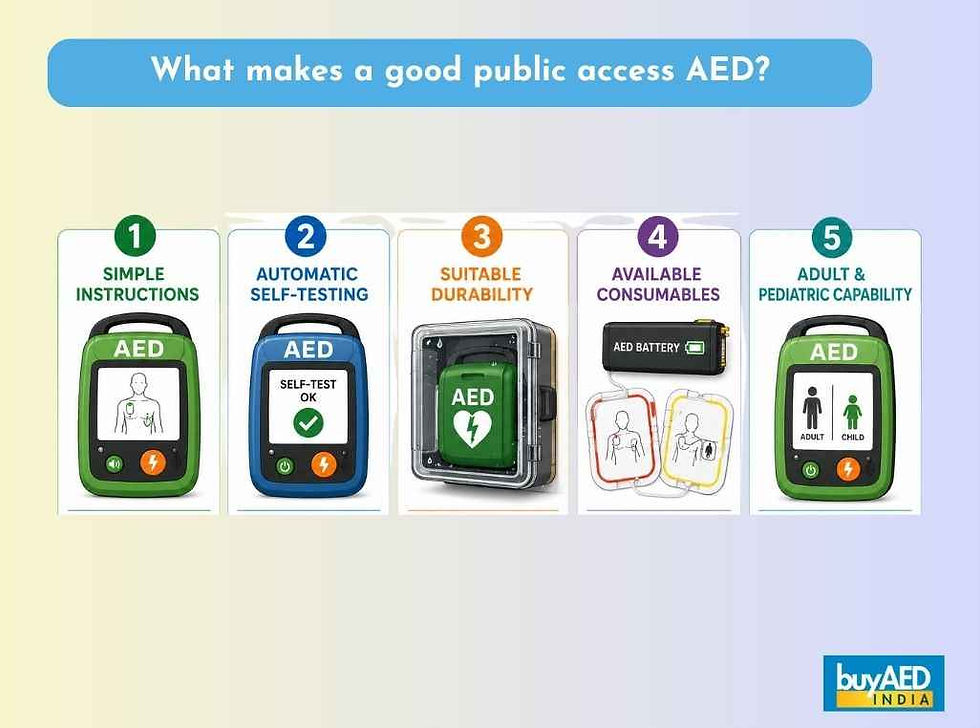
1. Simple instructions
Public responders may have little or no experience with defibrillators. Voice prompts, visual indicators and clear electrode-placement instructions can reduce uncertainty. The FDA notes that public-access AEDs are designed for laypeople who may have minimal training.
2. Automatic self-testing
Self-testing can help identify problems before an emergency. It should not, however, replace a documented inspection programme by the facility.
3. Suitable durability
Airports, malls and stations are busy environments. A durable enclosure and appropriate protection against dust or moisture may be useful depending on where the device will be installed.
4. Available consumables
Pads and batteries have usable lives. An AED is not truly ready just because the machine is sitting on a wall.
Buy AED India maintains an AED consumables range covering batteries, pads, accessories and related supplies. For facility managers, this highlights an important point: AED procurement should include the equipment’s ongoing readiness, not just the initial purchase.
5. Adult and pediatric capability
The appropriate configuration depends on the people using the facility. If children regularly visit a mall, airport or station, operators should confirm whether the selected AED supports pediatric use and which pads or settings are required.
For example, Buy AED India lists ZOLL Pedi-padz II as compatible with ZOLL AED Plus and AED Pro devices for pediatric use. Operators should always follow the particular manufacturer's instructions rather than assuming that pads are interchangeable.
Who Can Use an AED in a Public Place?
One of the biggest barriers to AED in public places India is the belief that only doctors, nurses or paramedics can use one.
In an emergency, the response should include activating local emergency medical services, starting CPR as appropriate and sending someone to retrieve the nearest AED. The device analyses the heart rhythm and determines whether a shock is appropriate. The responder follows the device prompts and continues CPR as instructed.
Training remains valuable. Airport security staff, mall security teams, housekeeping personnel, customer-service staff and railway employees can benefit from knowing where the device is located and how to coordinate the response.
A Practical Public AED Response Plan
Buying equipment is only one part of AED in public places India preparedness. A well-organised programme should answer six simple questions:
Where is the nearest AED?
Who checks it?
How can staff or the public access it?
Who activates emergency medical assistance?
Who starts CPR?
What happens after the AED is used?
The plan should be simple enough to follow under pressure.
Make the AED Easy to Find
A public AED should not become a scavenger hunt.
Use recognisable signage and keep the route to the equipment clear. If it is stored inside a cabinet, avoid placing furniture, advertising material or temporary structures in front of it.
Keep It Ready
Routine checks should cover the readiness indicator, battery condition, electrode-pad expiry, cabinet condition and supporting accessories.
After an AED is used, pads and other consumables may require replacement, and the device should be returned to a ready state according to the manufacturer's procedures.
Train Front-Line Staff
Security guards, customer-service personnel, station staff and other front-line workers are often among the people most likely to reach a collapsed person first. Training can help them respond with less hesitation and coordinate more effectively with emergency services.
How Should Airports, Malls and Stations Choose an AED?

The right choice depends on the location rather than a generic “best AED.” For AED in public places India, procurement teams should evaluate the following:
Factor | What to check |
Ease of use | Voice, visual and CPR guidance |
Readiness | Self-test and status indicators |
Durability | Protection suitable for the location |
Population | Adult and pediatric requirements |
Consumables | Pad and battery availability |
Support | Warranty, parts and service |
Access | Carry case, cabinet and signage needs |
AED brands catalogue is available on the Buy AED India website that has AED options from Philips, ZOLL, Defibtech and Cardiac Science.
For instance, its Defibtech Lifeline AED listing details the presence of two distinct buttons, voice guidance and a manufacturer's warranty of seven years.
The voice and text prompts, self-testing and pads and the battery provided with the Cardiac Science Powerheart G5 are described in the listing.
These differences highlight the need to assess AED in public places in India not only on the basis of popularity of brands but also on the basis of environment, response plan and population.
What about AED Cost and Ongoing Readiness?
The cost of AEDs is just a portion of the budget for AED in public places India. Alternate pads, batteries, cabinets, signage, training and periodic programme checks should be also considered as a replacement for public facilities.
Cut costs in the beginning do not always lead to lower ownership costs. Conversely, it may not make sense to make certain purchases for features that aren't needed for a specific environment.
What will it take to keep the AED ready for its working life?
When working with a large airport or railway station, procurement teams might need to take into account several devices, the installation, how users can access it, replacement inventory for staff, training of personnel, etc.
Several locations may be required for a mall, and a central register is required that lists the name of the location where each device is installed.
These days, public AED Programmes are more about than just the programme itself.
The most effective programme of AED in public places in India are a combination of three – equipment, personnel, and a system.
Equipment must be in working order. It needs to be known to people and how it can be retrieved.
It is important the AED be available and inspected and linked to the site's emergency response as part of the system.
Therefore, wall mounting an AED is not sufficient. Buy AED India carries AEDs and accessories and has other resources available for the public to learn about placement, operation and readiness.
Final Conclusion
Few people consider defibrillators when passing through an airport, walking down a mall or waiting for a train. This changes in a flash should someone collapse. The distinction between “we have an AED” and “we can get to an AED now” can be huge at this moment in time.
A public places India programme of AEDs requires more than a purchase order, however. It must be deployed strategically, have obvious signage, a trained staff, regular audit, and a plan to respond that remains effective in a busy, high-stakes environment.
If you're a facility and safety manager who needs to inspect public access options, Buy AED India offers AEDs from trusted brands, pads, batteries, and other necessary accessories.
Among different AED providers this website is much appreciated and known, so if someone is looking for new AEDs, we can explore different varieties of AED Devices and create an accessibility plan for public safety, readiness and quick response.
Frequently Asked Questions
Could airports and railway stations make use of AEDs?
Yes. Public access AEDs are intended for public areas, such as transportation areas. Airports are one of the typical areas that public access is granted according to FDA.
Will an untrained person be able to use a public AED?
Public Access AEDs are designed to help non-medical responders do the right thing. While CPR and AED training can boost confidence and preparedness, responders should always follow the instructions provided by the AED and call for emergency medical assistance.
In what location should an AED be located in a mall?
It should be visible, accessible and located following the property's emergency response plan. High traffic areas and locations that can be easily accessed should be evaluated, not on an arbitrary number of devices.
How often should public AEDs be inspected?
The readiness indicator, battery, expiry date on the electrodes and cabinet and accessories should be checked routinely.
Will an AED take the place of an ambulance?
No. An AED should be used as an early-response device and not a replacement for professional emergency medical services.


Comments