

Trauma Kit Price in India (Complete Buying Guide)


Whether it's a road crash happening along a major highway or an injury at work from working on a construction site or a heart attack in a hospital corridor, every second counts.
According to the Ministry of Road Transport and Highways' Road Accidents in India 2023 report, the country recorded 4.80 lakh road accidents that year, resulting in 1.73 lakh fatalities and injuries to 4.63 lakh people.
And the ‘pre-hospital window’, the time between getting injured and reaching an emergency department, is the period in which lives can be saved or lost.
A well-equipped trauma kit, with a trained individual, can control bleeding, stabilize broken fractures, clear airways, and keep a patient alive long enough to access surgical help.
However, the Indian market for trauma kits is broad and uneven, with basic consumer kits priced at a few hundred rupees and over a lakh for professional multi-patient systems.
Whether you're a safety officer working at an industrial site, an ambulance company considering how to improve your fleet, or a hospital administrator evaluating emergency department kits, this guide cuts through the clutter.
It includes insights into the price of trauma kits in India, the essential contents of each trauma kit, how to choose the correct one for your environment, and which verified options are worth considering.
Trauma Kit Price in India: A Practical Range Breakdown
Here is a realistic breakdown of what trauma kit price in India looks like across the main categories in 2026:

Please note that the prices listed above are tax-inclusive. Empty bag variants are priced much lower at each level than a comparable filled kit.
The ultimate choice isn't the cheapest kit for the same price.
It's about determining which kit size is best suited to a particular deployment scenario, PAX capacity, and setting, and whether you're looking for a kit you can bring to a deployment site or one you can use with your own consumables.
Top Trauma Kits Price in India
These are some of the best trauma kits available in India . All prices are tax-inclusive and include free shipping.
1. TK10 Trauma Kit

The TK10 trauma kit is designed for the single rescuer, first on scene.
It fits in a BLS ambulance bay, a factory first-aid area, or a school medical office and is designed for use with 10 patients.
Contents are all stored ready for use. Dressings and gloves are neatly stored, any airways are ready to use, and all wound care supplies are readily accessible, so this kit can be opened and used in seconds.
The TK10 is a well-balanced ambulance kit that is inexpensive for smaller ambulance operators operating BLS vehicles, or for clinic-based first responders who don't want to spend more on extra room they will never use.
It is also one of the more affordable options for organizations looking to purchase their first professional-grade trauma kit.
Price: ₹24,640
2. TK30 Trauma Kit
The TK30 trauma kit increases capacity to accommodate up to 30 patients, ideal for hospitals dealing with a moderate number of casualties per day, ALS ambulances, or industrial premises where there is a real need for multiple casualty events.
Construction firms, mining operations, and manufacturing plants that employ 100 or more workers should consider at least a TK30-equivalent.
The multi-compartment organization of the TK30 ensures that responders don't ration items when faced with a multi-patient scenario.
For a casualty room with 30 patients, it is good value for money in Tier 2 or Tier 3 cities where casualties are a reality, but budgets are often tightly controlled.
Price: ₹36,390
3. TK50 Trauma Kit

The TK50 trauma kit is the standard for large hospital emergency departments, event medical coverage at gatherings of 500 or more people, and ALS ambulances operating in high-density corridors.
At 50-patient capacity, it is the appropriate choice for government hospitals, large corporate hospitals, and stadium or venue medical teams.
A wide range of events are routinely held in India that bring large numbers of people together and can have multiple casualties in just one medical emergency, such as concerts, religious events, and sports tournaments.
A TK50 provides the on-site medical team with true multi-casualty response capability, rather than a third-patient scenario kit that runs out after the third patient.
The TK50 is the professional reference standard for large-scale trauma response in India.
Price: ₹50,400
4. Aris Trauma Kit
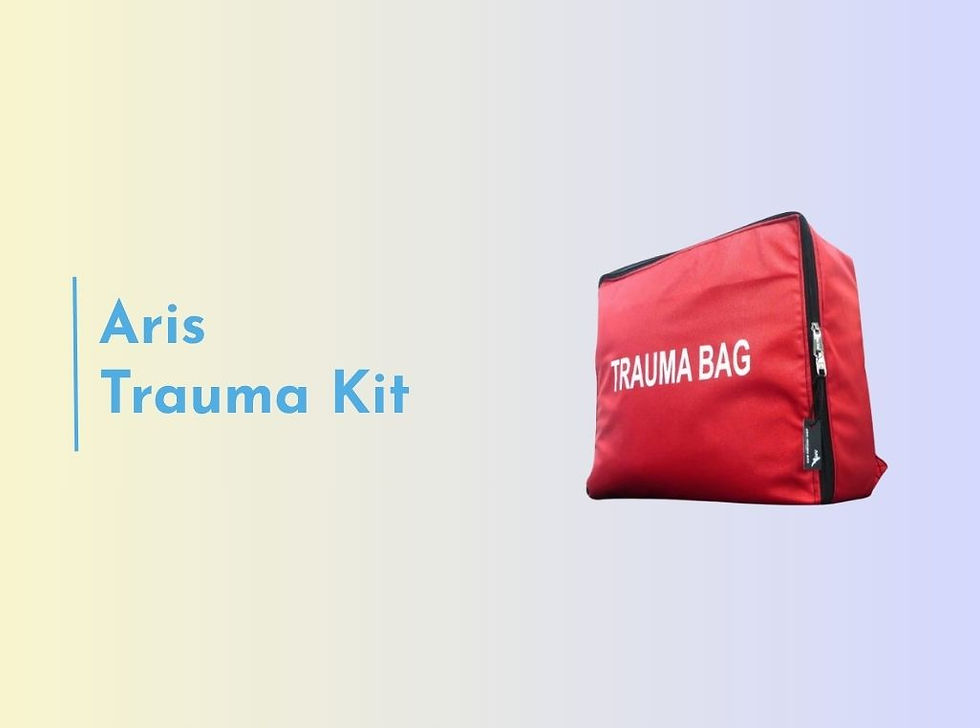
The Aris Trauma Kit is in a different league altogether.
It is a full-fledged Professional Trauma Response System at ₹1,40,000 for high-acuity situations, such as advanced life support ambulances, teams in advanced life support facilities, and hospitals with advanced life support protocols.
The Aris kit is not an entry-level kit, and it's not designed to be.
It is the right investment for organizations that require equipment more advanced than basic wound treatment for injury scenarios that are expected to be complex, such as penetrating trauma, multi-system injuries, or burn casualties.
The Aris Trauma Kit is for high-risk workplaces, such as refineries, mega-project construction sites, industrial emergency response teams, and private hospital chains, where a standard TK50 won't cover all situations.
Price: ₹1,40,000
For settings where a trauma response may also involve cardiac stabilization, pairing the Aris kit with top AED models in India creates a complete emergency response station capable of handling both trauma and cardiac events from a single location.
What Does the Trauma Kit Price in India Actually Reflect?
Before comparing prices, it is good to know what you are actually paying for. Two kits priced at ₹20,000 can be two entirely different products with two entirely different needs.
The key factor is PAX capacity. PAX (patients per kit) implies how many patients a kit can treat.
Each TK10 is used for 10 patients. A TK50 handles 50. The contents, or number of dressings, tourniquets, gloves, airways, and trauma pads, increase in proportion.
Paying ₹24,000 for a TK10 and ₹50,000 for a TK50 is not a question of brand premium. It depends on how many people you want to cover with your kit.
The second big difference is between filled and empty kits.
With an empty trauma bag comes an organizational system: the bag, the dividers, your color-coded sections. You stock it with consumables separately.
Filled kits are right for organizations starting fresh or standardizing across locations.
Filled kits are right for organizations starting fresh or standardizing across locations. Consumable quality drives price within the same tier.
Certified hemostatic gauze, CE-marked tourniquets, ISO-compliant gloves, and calibrated splints cost more than generic equivalents.
But in an actual trauma scenario, the performance difference is not marginal. It can be the difference between controlled bleeding and continued bleeding.
What is in a Hospital-Grade Trauma Kit?
There is a need for a wider range of injuries to be addressed in the trauma kit, which is used in the hospital, than in the ambulance kit.
In India, a hospital-grade trauma kit should contain at least Hemostatic dressings and wound packing gauze for controlling severe bleeding, tourniquets, chest seals (vented) for penetrating chest wounds, trauma scissors, and gloves.
CPR mask and airway adjuncts. Cervical collars in multiple sizes for spinal stabilization. Burn dressings for thermal injuries, which are common in India across industrial and domestic accident categories.
Space blankets to prevent hypothermia during stabilization.
Hospital kits should also have well-defined compartments for items so that responders, who are under stress while looking for an item, can easily find it.
Internal dividers should be color-coded, labels should be clear, and the layout should be uniform across all kits in a facility, resulting in a significant reduction in response time.
A team that trains with a specific kit layout should find the same layout every time they open a kit in an emergency.
What Belongs in an Ambulance Trauma Kit?
The constraints of an ambulance kit are different. Space is limited. The kit should be portable, operate with one hand, and be deployable at a roadside, not just in a clean treatment room.
Ambulance-ready trauma kits are an extremely important component of the pre-hospital chain, as the burden of road trauma in India is the largest in the world as per absolute numbers.
The ALS and BLS ambulance specifications in India require a specified set of equipment to be available on the ambulance.
If the contents of a trauma kit are verified, this will safeguard both the patient and the service provider from compliance issues.
Portability should be the key factor in an ambulance trauma kit.
It should fit in a specific bay, be single-person portable to the site of collapse, and provide immediate interventions with bleeding control, airway management, and simple immobilization, without the need for secondary equipment from the vehicle.
A clearly marked bag with a carry handle or shoulder strap, water resistance, and rugged construction is the baseline requirement.
Hospital vs Ambulance: How the Buying Decision Differs?
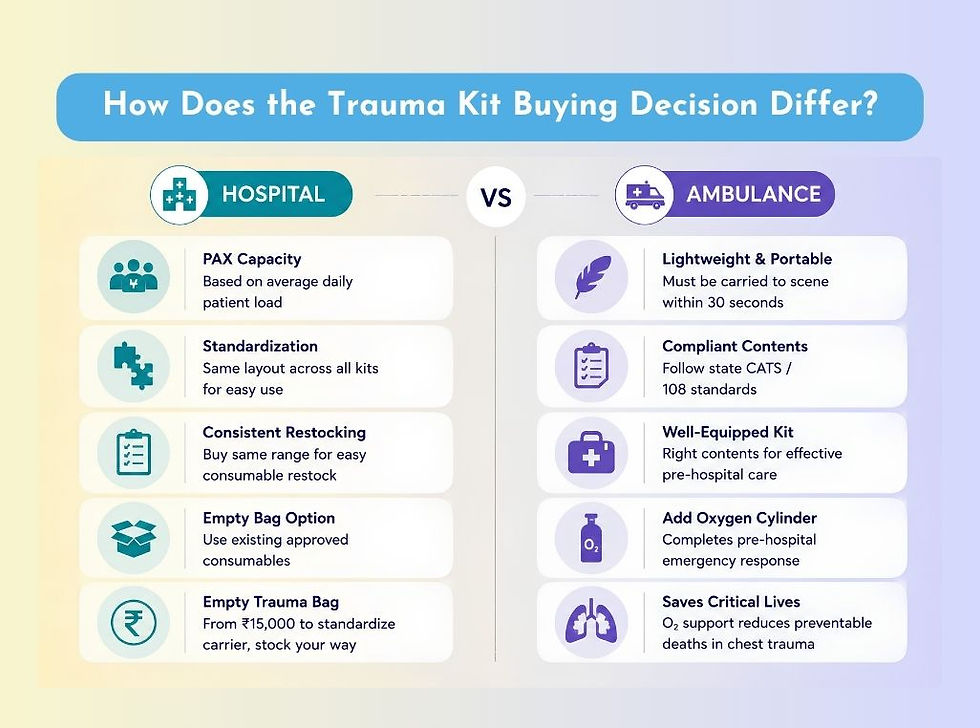
The first factor for hospitals is PAX capacity, based on the average number of patients per day in the casualty and other departments, followed by standardization of contents.
A multi-casualty bay hospital should standardize the layout of all kits so that anyone who knows one can use another without having to learn a new layout.
Buying multiple kits from the same range also ensures consistent consumable restocking.
If hospitals have existing, approved stock of consumables, they can also consider empty-bag options.
The empty trauma bag, starting at ₹15,000, allows procurement teams to standardize the carrier system while stocking from their existing approved supplier lists.
Weight and portability are key for ambulances, as is content. No matter how well-stocked the kit is, if one Ambulance member cannot carry it to a road scene within 30 seconds, it does not meet Ambulance requirements.
Ambulance operators should also check that the contents of the kit comply with state-level CATS or ambulance standards (108).
The trauma kit, when combined with a portable oxygen cylinder, completes the pre-hospital emergency response capacity in India.
Especially when the O2 is needed due to respiratory compromise in the immediate aftermath of chest trauma, which is one of the most preventable types of death in the pre-hospital window.
What to Verify Before You Buy a Trauma Kit in India?
These are the questions to ask before making any decision to buy a trauma kit in India.
Are the consumables inside certified?
ISO or CE markings on dressings, gloves, and airways confirm the materials meet minimum clinical performance standards.
Generic consumables from unverified sources can fail in ways that are not visible until they matter.
Is the PAX rating verified or estimated?
Some Supplies indicate PAX capacity by the number of items, rather than by clinical protocol requirements. A kit labeled TK10 with 10 pairs of gloves isn't necessarily sufficient to handle 10 patients through a full trauma protocol.
Are replacement consumables available from the same source?
A kit that uses consumables that you can't restock here in India is a liability once used. Ensure that the supplier can supply replacement dressings, pads, tourniquets, and other single-use items.
What is the bag's IP rating?
The bag should be water-resistant for use in an ambulance or outdoors. Without a water-resistant kit, a kit kept roadside will deteriorate before its consumables expire due to the monsoon.
Does the first responder team know how to use what is inside?
All of these are useless if a person on the scene does not know them.
CPR and first aid training in India complement the equipment purchase and enhance human capability, ensuring the investment pays off in the event of a real emergency.
Buying Guide for Trauma Kit in India
Trauma kit prices in India in 2026 range from a few hundred rupees for basic consumer kits to over a lakh for professional multi-patient systems.
For your organization, the key is not the lowest price.
It is the price of a kit that supports the correct number of patients, includes verified consumables, meets your deployment needs, and is supported by a supplier that can restock.
For hospitals, ambulances, industrial sites, and large public facilities across India, the difference between a kit that performs and one that does not often comes down to decisions made before the emergency.
Buy AED India is the dedicated safety platform to look to for a complete range of certified, professionally strong trauma kits, with taxes included and free shipping throughout India.
Frequently Asked Questions
1) What is the average trauma kit price in India for a hospital setting?
The price range of the product is from ₹24,000 (10-patient kit) to ₹1,40,000 (more advanced system), depending on volume and stock.
2) What is the difference between a trauma kit and a first aid kit?
First aid is used for minor injuries, such as cuts and burns. Trauma kits provide equipment and agents for life-threatening emergencies (tourniquettes, chest seals, hemostatics).
3) Can a trauma kit be used by someone without medical training?
Basic items (gloves, wraps) require no training, but advanced gear (chest seals, airway tools) requires trained responders.
4) Does an ambulance trauma kit need to meet any regulatory standard in India?
Yes. They must meet state-specific ALS/BLS standards and NABH accreditation rules (such as 108 ambulance networks). Buy from suppliers who provide compliance documentation.
5) Is it better to buy an empty trauma bag and stock it separately?
Empty Bag is ideal for facilities already set up with existing supply flows and clinical protocols.
For new setups and to simplify procurement for multi-site standardization, a pre-filled kit is best.


Comments