

AED Battery Replacement Guide: What Every AED Owner in India Must Know?

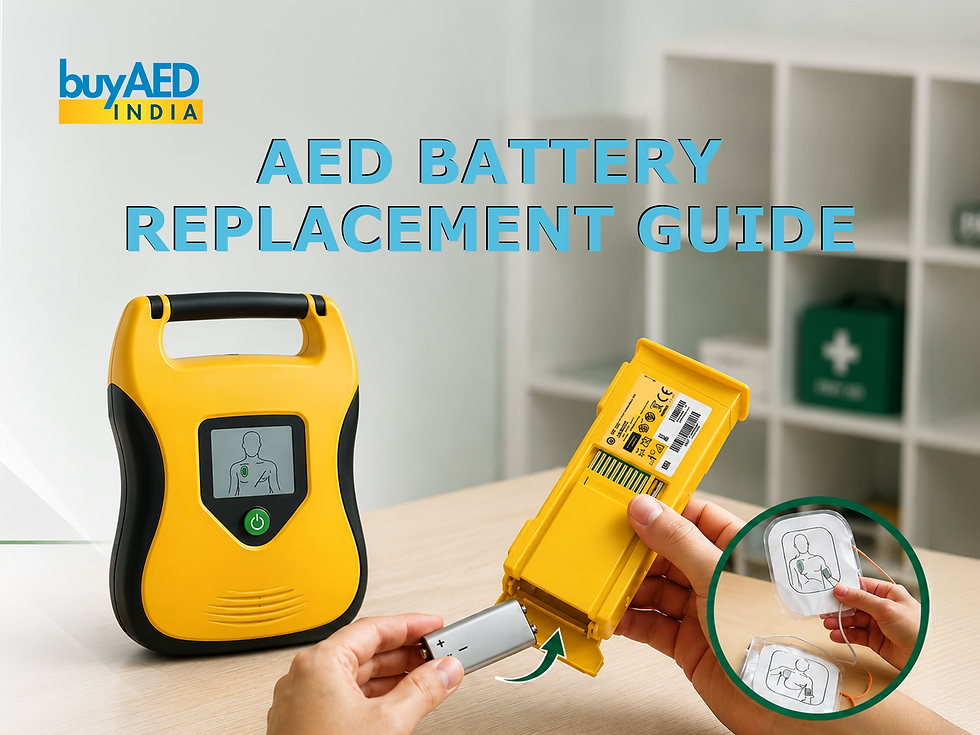
Almost 1 out of 5 AEDs fail to work during a cardiac emergency. It is not because of any fault or manufacturing defect.
It's a used or drained battery, which can be avoided with proper care.
With more than 7 lakh deaths due to Sudden Cardiac Arrest in India every year and the response time of ambulances being 15 to 30 minutes in most cities, an AED that doesn't start is no backup plan.
It's a safety hole that should not exist.
Everything the AED does, such as daily self-testing, rhythm analysis, and delivering a shock to restore normal heart rhythm. It is powered by an AED battery.
Even the most sophisticated defibrillator is just a wall-mounted box without a working battery.
Whether it's the battery's expiration date or its brand, this AED battery replacement guide offers a comprehensive look at everything AED owners in India should know.
If your organization has an AED but you don't know when the battery was last changed or how to replace it, then you should continue reading.
Why AED Batteries Deserve More Attention?
When many people buy an AED, they put a lot of effort into choosing one, and then they assume the device will take care of itself.
AEDs will automatically conduct self-tests and indicate most problems with a status indicator.
However, the self-test's reliability depends on the reliability of its parts.
A battery that is working perfectly may still be near the end of its life but pass a normal self-check, and then fail under the higher power demand of delivering a defibrillation shock.
This is the gap that catches organizations off guard. The device was seemingly all set. The green light was on. Then, in a cardiac emergency, it failed to perform.
In a significant examination of AED failures, nearly half were related to the battery or pad, with battery problems accounting for about 23% and faulty pads for another 23%.
The majority of those failures could have been avoided if the repairs and tracking had been completed on time. The first step is to understand the AED battery life cycle for your device.
How Long Does an AED Battery Last? A Brand-by-Brand Overview
Different batteries and battery types have different lifespans.
The following is a standby life, the amount of time an AED battery will last when it's in the device, performing periodic self-tests.
1) Philips HeartStart (M5070A): It has a standby life of about 4 years after installation. The Philips AED battery carries an "Install Before" date rather than an expiration date.
This is the shelf life of the battery before installation, typically 5 years from the date of manufacture.
After installation, the 4-year standby clock starts. It is important to note the installation date, as the battery itself will not show the expiry date after installation.
2) ZOLL AED Plus: The ZOLL AED Plus is one of the lowest-maintenance AED brands, with batteries and pads changing every 5 years. A disposable 10-lithium battery sleeve powers it, and all 10 batteries must be replaced at once.
Replacing only some of them risks the device signaling readiness while lacking the full power required for a rescue.
3) Cardiac Science Powerheart G3: Cardiac Science Powerheart G3 offers approximately 4 years of standby battery life and includes an automatic self-test system that records the readiness of the device and alerts to problems.
4) ZOLL AED 3: Zoll AED 3 is a smart battery that lasts 5 years and has a built-in self-testing feature for easy maintenance tracking in multi-device programs.
In general, across all brands, Battery failure is the No. 1 reason AEDs are not ready during a cardiac emergency, and most AED batteries last 2 – 5 years after installation, depending on the brand and model.
Be sure to check the exact replacement time for your device in its operator's manual, since different models in the same brand line may have different replacement times.
The Warning Signs That a Battery Replacement Is Due
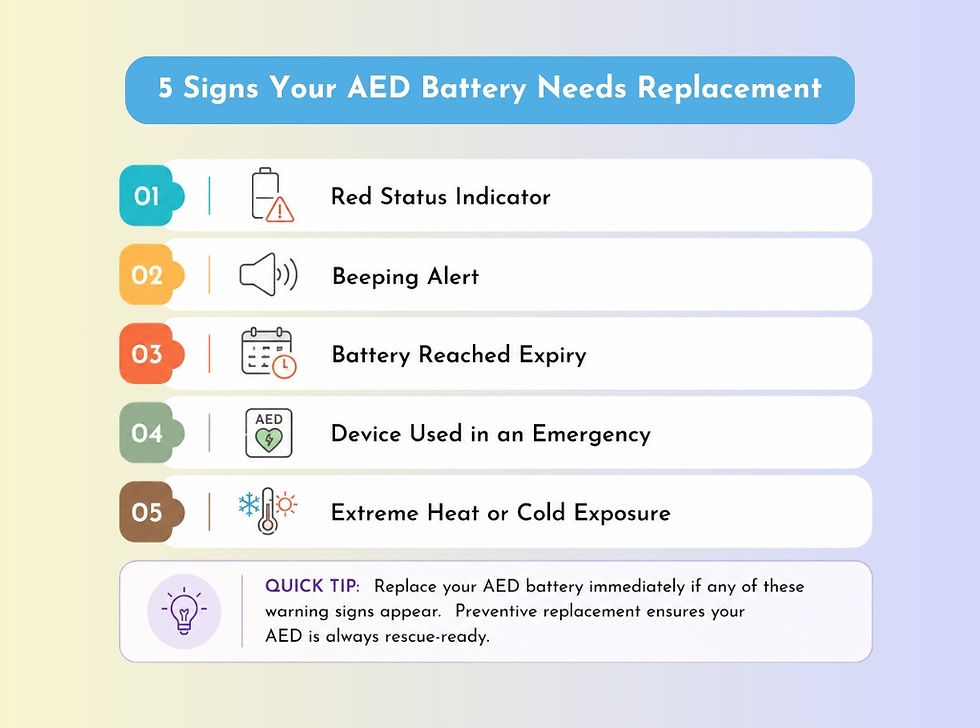
If you know what to look for, AEDs will clearly communicate their status. Do not wait for a device to stop functioning. This is not a monitoring strategy. Here are the signals to act on now.
1) The status indicator has changed
Most AEDs will display a green light or ready indicator when the device is working properly.
An X symbol, a flashing light, or a red indicator means that the device has detected a problem.
The most often-used trigger is battery condition. Any device that is not in its normal, ready state should be considered non-operational until checked.
2) The device is beeping or sounding alerts
One of the most common warning signs of an AED battery problem is an unexpected beep.
If the AED is sounding alarms, it has not been verified to be in a ready state until the cause is determined and corrected. Never ignore the warning and expect it to go away.
3) The battery has reached its expiry
The battery should be replaced after 4 years for a Philips or 5 years for a ZOLL, even if the equipment appears to be working properly.
Proactive replacement before expiry is the standard in any well-run AED program.
4) The device was used in an emergency
Each usage extracts a considerable amount of battery life.
After each emergency, AED batteries should be replaced, as they consume a significant amount of power.
A used battery should not be relied upon to power a second rescue at full capacity.
5) The battery was stored in a challenging condition
AED batteries cannot last long in extreme heat or cold. Batteries will drain quickly in hot conditions and may be affected by very cold temperatures.
Batteries in unregulated environments may degrade ahead of their stated lifespan.
How to Replace an AED Battery? The Step-by-Step Process
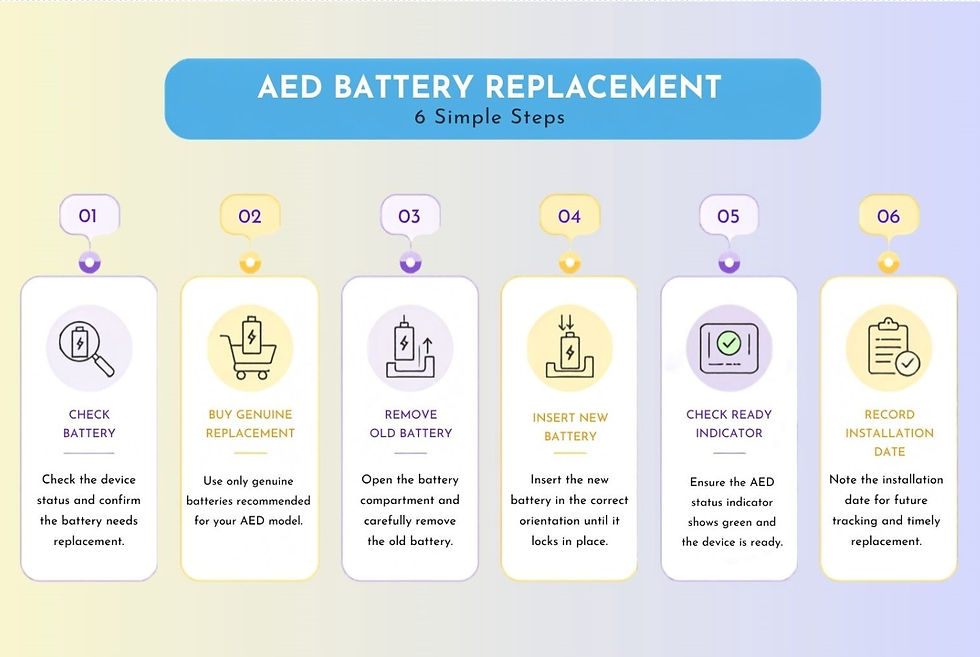
Replacement is very simple with most AED models and doesn't require a technician.
It only requires a proper replacement battery from a trusted supplier, the device's operating handbook, and a record of the installation date.
1) Confirm the correct battery model
There are several AED brands and models, each with its own battery.
An incompatible replacement may harm the device, cause a false readiness reading, or invalidate the warranty. Please refer to the operator manual for the proper model number, or check the battery currently installed in the device.
2) Source a genuine replacement
There is a real risk with generic or unverified batteries. Use batteries that are recommended by the manufacturer and purchased from an authorized battery distributor.
For Indian buyers, confirming that the replacement battery is genuine and appropriately certified before purchase is non-negotiable for a life-safety device.
3) Power down and open the battery compartment
Most AED models have an easily accessible battery compartment. Check the manual for your particular device.
For example, Philips HeartStart employs a release tab mechanism. The battery sleeve in ZOLL devices is located on the back panel, which must be removed to access the battery.
Defibtech models have an eject button on the side. Never force the compartment open.
4) Remove the old battery and insert the new one
Gently remove the old battery. Insert the new battery until it clicks or sits snugly.
For the ZOLL AED Plus, place each of the 10 batteries into the device according to the instructions in the operator manual, in the correct orientation and sequence.
5) Verify readiness
Turn on the unit and see if the status indicator is in its ready state.
Once the device accepts the new battery and completes a post-replacement self-check, it will display a green light or a "Ready" message.
6) Log the installation date and schedule the next replacement
It is the step that most organizations miss out on and then regret. Document the brand, model, installation date, and replacement date of the battery in your AED maintenance log.
If a property is managing multiple devices, a manual log is an acceptable option to manage 1 or 2 properties. Anything else is worth considering a digital tracking system, such as AED SmartX.
Why AED Battery Tracking Gets Overlooked?
In Indian workplaces, schools, and public facilities, AED maintenance is rarely assigned to a dedicated role.
It is bought, installed with good intentions, and never used again. Checks, which are supposed to be done monthly, are not conducted during busy times.
Replacement dates that were noted on a sticky label inside a cabinet get overlooked.
This isn't a failure of intent. It's a problem with the system. If an organization relies on memory or informal checks to track AED battery status, it will find a non-functional AED at the worst possible moment.
That is why having a management system for AEDs, like AED SmartX, is important. It sends automatic reminders before battery and pad expiration and maintains a compliance record for all units in the program.
The AED maintenance guide provides an inspection schedule for AED program owners in India to follow, including monthly checks, quarterly documentation reviews, and replacement of consumables well before they expire.
The practical answer is to incorporate this into an organization's safety calendar.
Managing Battery Replacement Across Multiple AED Units
Tracking a single device is relatively easy and can be done manually. A more structured approach is required for 2-3 devices within a building.
If there are 5 or more AEDs spread throughout a floor, building, or multiple locations, then an automated program is necessary.
AED SmartX is designed to do just that. All software records the battery installation date and logs self-test results.
It provides automatic reminders before battery or pad expiration and maintains a compliance record for every device in the program.
This sort of visibility is not a luxury. It's a necessity for a corporate campus, a hospital network, or a hotel group with AEDs located on various floors and across different locations.
The cost of a replacement battery is a fraction of the cost of a failed rescue or a post-incident compliance review.
Battery Replacement and Electrode Pads
Battery replacement is not performed alone, but in conjunction with the rest of AED maintenance.
Electrode pads have their own expiration date and should be monitored alongside the batteries as part of a unified consumables management process.
The adhesive gel dries out over time, causing AED electrode pads to expire every two to four years.
In India's high-temperature, humid coastal conditions, outdoor storage of the pads can cause degradation before the guaranteed shelf life is reached.
The practical consequences of expired pads, such as poor adhesion, inaccurate rhythm analysis, and failed shock delivery, mirror those of a failed battery.
When replacing a battery, it is also good practice to check the pad's expiry date.
When both are nearing their end dates within the same 12-month period, it is possible to replace both at once, without having to replace the second one soon after.
Genuine replacement electrode pads for all major AED brands are available in India with confirmed expiry dates, a guarantee not always available through unverified dealers on general marketplaces.
Training Staff to Recognize and Respond to Battery Alerts
The knowledge of the need to replace an AED's battery can differ from the action to take.
Dedicated AED maintenance personnel are better equipped not only to access the status indicator but also to understand its meaning, identify the correct replacement part, and log the intervention correctly.
Think Health provides AED trainer units to get hands-on experience with the complete AED. Trainer units are mainly used for cardiac emergency drills.
Still, the confidence that they develop with the device, such as the battery compartment, status indicators, and self-test signals, directly translates to improved staff competency when maintaining the device.
The AED training pads enable the team to practice the entire rescue procedure, thereby increasing overall confidence in the device and reducing the likelihood of routine maintenance checks being mishandled.
Where to Get Verified AED Replacement Batteries in India?
Many AED owners make a big mistake on this. Near-expiry stock or alternative batteries that are incompatible with the device and have been re-labeled by an uncertified seller on a general marketplace may be uncertified imports.
If a battery isn't fit for use, can't communicate with the device's internal systems, or has an incorrectly printed expiration date, it can present a dangerous false readiness condition.
Buy AED India provides genuine, manufacturer-approved replacement batteries for Philips, ZOLL, Cardiac Science, and Defibtech AEDs, which are confirmed to expire on the indicated date and are fully documented.
When replacing batteries, every replacement battery provided is guaranteed to be brand-authorized, which is important to prepare the device for a real cardiac emergency.
Conclusion
An AED is a life-saving device, and its effectiveness depends entirely on regular, scheduled maintenance, including battery replacement, the most important component.
This AED battery replacement guide is applicable to an individual with one device in a small office or to a multi-site program across an organization.
The procedures involved are not difficult: identify the device's battery model, note the installation date, replace the battery before its expiration date, and check readiness after the battery replacement.
The problem is that these steps are not consistently followed when they rely on informal arrangements, verbal reminders, or memory. None of which is as consistent or as large-scale as a life safety program.
Buy AED India offers verified replacement batteries, brand-authorized consumables, and the entire spectrum of AED maintenance support in India.
Frequently Asked Questions
1) How often should I replace my AED battery in India?
Replacement time depends on the brand and model. Check the operator's manual for the model-specific replacement time, and note the installation date when replacing the device.
2) Can I use a non-original battery to replace my AED battery?
It is not recommended to use a non-original or incompatible battery.
3) What happens if the AED battery expires but the device still shows a green light?
Some devices will continue to display a ready status even when the battery is near or past its end-of-life, particularly if the power drain required for self-tests is lower than what is needed for a shock.
4) How should I dispose of an expired AED battery in India?
AED batteries are Lithium-type batteries and are considered e-waste. Do not put it in the general waste. Call a certified e-waste disposal service in your city or ask your AED supplier for advice on disposal.
5) Where can I track pad and battery expiry dates for multiple AED units across our organization?
A digital AED program management tool, such as AED SmartX, is the most reliable solution for organizations with two or more AEDs.


Comments