

Can You Use an AED on a Child? Pediatric AED Pads Explained


Although sudden cardiac death in children is uncommon, when it occurs, it is one of the most shocking emergencies a bystander, parent, teacher, or school nurse can encounter.
The instinct to act is there. What stops most people is uncertainty: can you actually use an AED on a child, or will the shock be too strong?
Understanding the safety of using an AED is very important.
Cardiac arrest caused by a shockable rhythm in children has a far higher survival rate than non-shockable causes, and defibrillation delivered early is what determines that outcome.
Every minute without a shock reduces survival by 7-10%. In India, where cardiac arrest survival rates outside the hospital are already below 10% for adults, children deserve an equally prepared AED response.
This guide covers all the information a school, hospital, sports facility, parent, or safety officer needs to know about AEDs for children.
Using an AED on a Child is Actually Safe
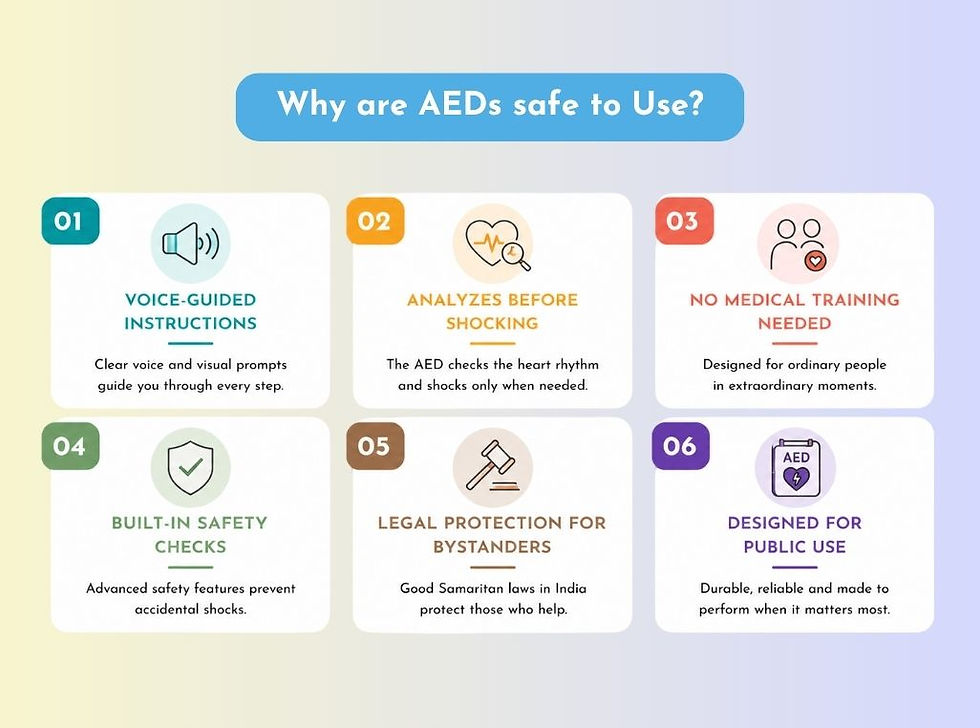
Yup, AED can be safely used on children. In fact, the American Heart Association and European Resuscitation Council guidelines both specifically state the use of AED for children with a sudden cardiac arrest (S.C.A.) from a shockable rhythm.
The important distinction is age and weight. In general, pediatric protocols are used for children younger than 8 years or weighing less than 25 kg.
Children over 8 years of age (and over 25 kg) may use a normal adult pad and normal energy setup.
The question is not whether or not an AED will work for children under 8 years of age or under 25 kg. The energy of adults can be too much for a small body.
For adults, an AED shock is designed according to the size of the adult's body and heart.
That same amount of energy to a child can cause myocardial damage.
This is exactly what pediatric pads (and pediatric-mode AEDs) are designed to prevent.
If a pediatric AED is not available, using an adult AED with adult pads on a child who is under 8 years of age is better than doing nothing.
The AHA is clear on this: if no pediatric-capable device is available, use what you have. A potentially oversized shock gives the child a chance. No shock does not.
What Are Pediatric AED Pads and How Do They Work?
Pediatric AED pads are pads used exclusively on children under 8 years old and/or under 25 kg. There are three important ways they differ from adult pads.
1) Smaller pad size
Adult-sized pads may overlap on a child's chest, which creates a short-circuit path for the electrical current, reducing shock effectiveness and potentially causing skin burns. Pediatric pads are sized to fit without overlapping.
2) Reduced energy delivery
For the adult patient, standard AED shocks are 150-360j depending on the machine.
Pediatric pads are used with the AED and automatically lower the delivered energy to a safer, clinically appropriate level.
3) Pediatric-specific ECG analysis
This is because children's heart rhythms differ from those of adults, and their arrhythmias differ as well.
Pediatric pads (and AEDs designed to work with them) have ECG analysis algorithms optimized for pediatric cardiac physiology.
This enhances the accuracy of rhythm interpretation and minimizes the risk of delivering the wrong shock.
To reduce the energy delivered to the child, some AEDs have a switch that puts them into a pediatric mode automatically.
Models such as the Philips HeartStart FRx have a switch or key to switch the device to the pediatric mode, but not a different set of pads.
AED Pad Placement for a Child
Adult AED pads are applied in the standard positions: one below the right collarbone and one to the left of the heart at the bottom of the chest.
AED pad placement options depend on the child's size.
The standard anterior-lateral (as in adults) is well suited to children who are larger (near 25 kg) and use pediatric-sized pads.
For smaller kids and infants, the anterior-posterior pad placement works best: a pad at the center of the chest and a pad at the center of the back, between the shoulder blades.
This avoids overlap of the pads, ensures good skin contact, and enables good current flow through the heart.
Each set of pediatric AED pads includes a placement diagram, both on the pad and in the packaging.
AEDs with pediatric mode provide voice prompts specific to pediatric pad placement.
The device leads the user through all the steps. There's no need to memorize the changes. The key is knowing what pads to go for.
Pediatric AED Pads Price in India
1) The Philips HeartStart FRx Infant/Child Key

For most Indian organizations, the easiest way to be ready for a pediatric AED is to buy the Philips HeartStart FRx Infant/Child Key for ₹6500 (Inclusive of Tax), with free shipping.
This isn't a set of pads. It's a small accessory key that can be plugged into the Philips HeartStart FRx AED to switch the defibrillator into pediatric mode in just one click.
The FRx automatically adjusts its energy output to a safe pediatric level when the key is inserted and activates the child-specific voice prompts.
The same adult pads remain on the device. The key handles the mode switch entirely.
The practical advantage is significant. No extra track keeping of pads and no second expiry date to manage next to the adult pads, plus no confusion in an emergency.
This key does not expire, unlike electrode pads. It is compatible exclusively with the Philips HeartStart FRx.
2) ZOLL Pedi-Padz II (8900-0810-01)

The ZOLL Pedi-Padz II is a pediatric electrode pad designed for those who operate ZOLL AEDs. It's priced at ₹16,000, taxes included, with free shipping.
What sets the ZOLL Pedi-Padz II apart is its automatic recognition capability.
When the pads are connected to the ZOLL AED Plus, the device instantly identifies them as pediatric electrodes and transitions to pediatric ECG analysis and pediatric energy delivery, without any manual configuration.
The responder need not go through a menu, press a button, or make a clinical decision. The system automatically handles the pediatric adjustment, so there are no configuration issues during high-stress rescues.
3) Defibtech Pediatric Defibrillation Pads DDP-2002 — ₹24,000
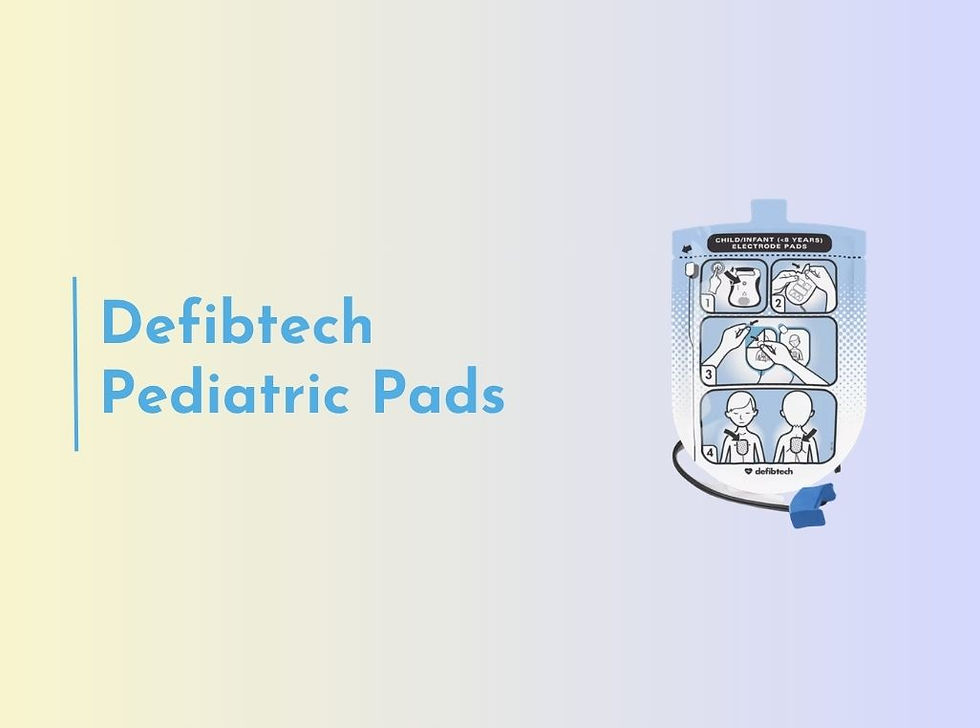
Defibtech AED users have a dedicated pediatric option in the Defibtech Pediatric Defibrillation Pads DDP-2002, available at ₹24,000, taxes included, with free shipping.
The DDP-2002 is designed for use with Defibtech Lifeline AEDs on children under 8 years of age or under 55 pounds (approximately 25 kg).
Like the ZOLL Pedi-Padz II, these pads communicate with the AED to deliver reduced, pediatric-appropriate energy levels.
4) ZOLL CPR Uni-Padz II (Adult/Pediatric Universal)

The ZOLL CPR Uni-Padz II is the universal solution, ideal for organizations that wish to use just one set of electrode pads for both adults and children without changing or swapping out equipment.
It is available at ₹40,000, taxes included, with free shipping.
The Uni-Padz II is a single-pad system, suitable for use on both adult and pediatric patients.
The pads on the body help the AED determine the patient's size and clinical need, which dictate the amount of energy it delivers.
This eliminates the need to maintain a separate set of pediatric pads alongside adult pads.
Which AEDs Support Pediatric Mode in India?
Not all the AEDs available commercially can be used for pediatric defibrillation. Pediatric capability should be a non-negotiable specification for any AED selected for a location where children are present.
1) Philips HeartStart FRx
An infant/Child Key accessory is required to activate pediatric mode on the Philips HeartStart FRx.
It is one of the most popular AEDs recommended for schools, gyms, and public places in India.
Its pediatric mode is the simplest to activate: a single key insertion, with no mode changes required.
It is available at ₹1,20,000.
2) Philips HeartStart HS1
Philips HearStart HS1 has a separate cartridge for defibrillating infants and children (SMART Pads).
It can be installed in high-traffic areas and hospitals.
3) ZOLL AED Plus
Zoll AED Plus automatically switches to pediatric mode when ZOLL Pedi-Padz II is detected.
It has built-in CPR feedback.
It is available at ₹2,00,000.
If the children are regularly present at a place, such as a school or a residential setting, selecting an AED with a built-in or key-initiated pediatric mode is the norm.
Purchasing an AED for adults and expecting pediatric pads to be available when required is not preparedness.
What Happens If You Use Adult Pads on a Child in an Emergency?

If a pediatric pad or pediatric key is not available and the child has cardiac arrest, use the adult AED and adult pads.
Avoid waiting for pediatric-specific equipment if it's not available.
If the child is 1-8 years old and pediatric pads are not available, position 1 pad over the center of the chest and 1 pad over the center of the back to avoid overlapping.
Follow the AED's instructions precisely. The device will analyze the rhythm and recommend whether to deliver a shock.
The risk of a modestly greater shock in a child who needs defibrillation is significantly lower than the certainty of death from untreated cardiac arrest.
Any defibrillation is better than no defibrillation.
Understanding AED pad compatibility and what the device does when pads are applied removes the hesitation that costs the most time in a real emergency.
Regular Maintenance and Tracking for Pediatric Pads
The pads used on pediatric defibrillators have their own expiration date, usually 2 years for most models.
This is shorter than most adult pad expiry periods, which means it's important to track it proactively.
Organizations with multiple AEDs throughout a facility, a hospital with pediatric and adult departments, a school campus, or a sports complex struggle to manually track the expiry dates of the adult and pediatric pads.
AED management platform, AED SmartX, tracks all consumables for each device across all devices in a program, including adult pads, pediatric pads, batteries, and accessories, in a single digital dashboard.
It tracks inspections, generates notifications just before expiration, and maintains a compliance audit trail.
AED readiness across organizations in India is an emerging compliance topic, and AED safety standards are increasingly referenced in institutional safety planning.
Practicing Pediatric AED Response Before an Emergency
Having knowledge and being willing to act in an emergency are two entirely different things, particularly when it comes to using an AED on a child. Training fills that gap.
Think Health offers professional CPR and AED training programs and AED trainer units that enable complete scenario training without the risk of electric shock.
These trainer units, in combination with pediatric manikins with child-sized proportions, enable responders to practice pad placement and anterior-posterior positioning for infants.
If a school, pediatric hospital, or sports facility conducts regular first-aid drills, add a pediatric scenario to the program (at least once or twice a year) so that the right instincts are in place when needed.
AED training pads compatible with trainer units allow the full pad application sequence to be practiced accurately, including the positioning differences between adult and child patients.
AED Usage on a Child
In India, the use of an AED to rescue children is not only feasible but also the correct approach when a child goes into cardiac arrest.
There is technology available to deliver defibrillation in a way that is safe, automatic, child-sized, and physiologically appropriate.
The problem is not the device. It is whether the right pads, the right training, and the right awareness are in place before an emergency happens.
Models such as the Philips FRx Child Key, ZOLL Pedi-Padz II, Defibtech DDP-2002, and ZOLL CPR Uni-Padz II are among the reliable pediatric AED options currently available in the Indian market.
All the schools, pediatric hospitals, sports centers, and family-friendly public areas in India should have at least one of them.
Buy AED India is a dedicated platform in India for pediatric AED pads, AED devices with pediatric capabilities, and training resources to create pediatric emergency readiness at your organization.
Frequently Asked Questions
1) Can an AED be used on a child in India?
Yes. AEDs can be used on children. For children under 8 years or under 25 kg, use pediatric pads or a pediatric mode accessory to deliver age-appropriate energy levels.
2) What is the age and weight cutoff for pediatric AED pads?
Most pediatric AED protocols apply to children under 8 years of age or under 25 kilograms.
3) Do pediatric AED pads expire faster than adult pads?
Yes, in many cases. The ZOLL Pedi-Padz II, for example, carries a 24-month shelf life compared to the 2-4-year shelf life of most adult pads.
4) What happens if I use adult pads on a child and there are no pediatric pads available?
You can use adult pads with caution. The risk of a slightly oversized shock is far lower than the risk of not defibrillating at all. Place one on the center of the chest and one on the center of the back for children under 8 to avoid pad overlap.
5) Is the Philips FRx Infant/Child Key reusable?
Yes. Unlike electrode pads, the Philips FRx Infant/Child Key has no expiry date and does not need to be replaced after use.
6) Where can I buy pediatric AED pads in India?
Verified, brand-authorized pediatric AED pads and accessories for Philips, ZOLL, and Defibtech AEDs are available on reliable platforms, such as Buy AED India.


Comments