

Is Using an AED Safe? Myths vs Facts Every Indian Should Know

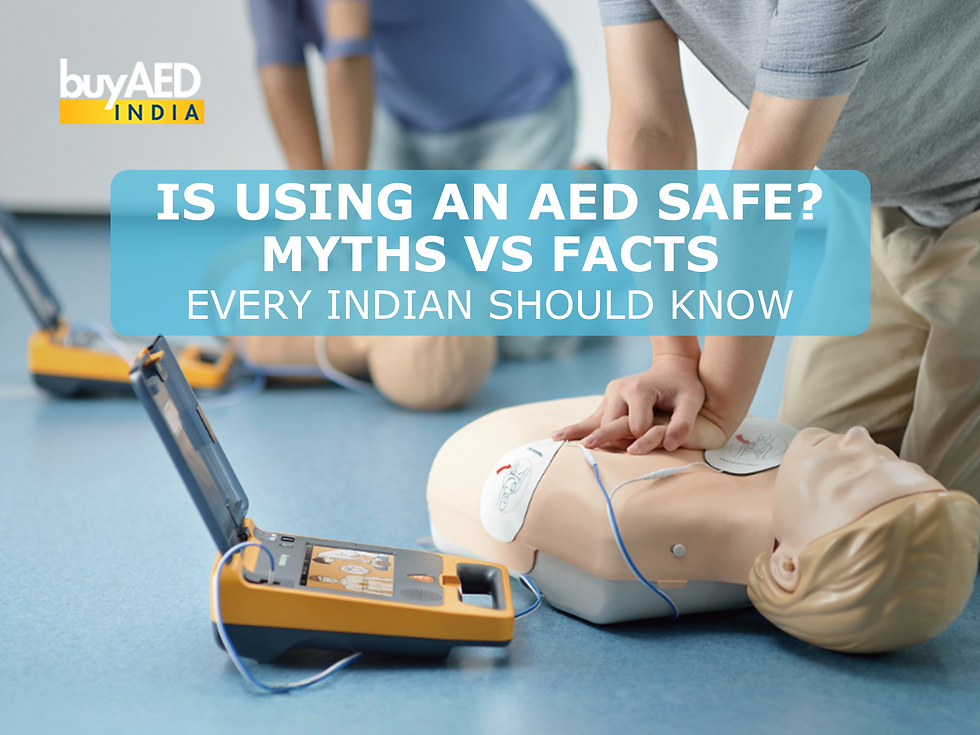
Sudden cardiac arrest claims more than 7 lakh lives in India annually, and almost 80% of these collapses occur outside hospitals, in offices, gyms, residential complexes, and public places.
AEDs are not the problem: fewer than 10% of people survive because those nearby don't want to act. The main reason for this hesitation is that most people have not been informed whether using an AED (Automated External Defibrillator) is safe.
The answer is yes. But the myths are strong, and they do indeed cost lives.
In cities across India, where it takes 15 to 30 minutes for an ambulance to arrive, every minute without defibrillation reduces the odds of survival by 7-10%.
If a bystander wastes a minute thinking about a myth, they are making a decision that carries real consequences.
The following 10 myths tackle the most common fears head-on with facts.
10 Myths related to AED: Every Indian Should Know
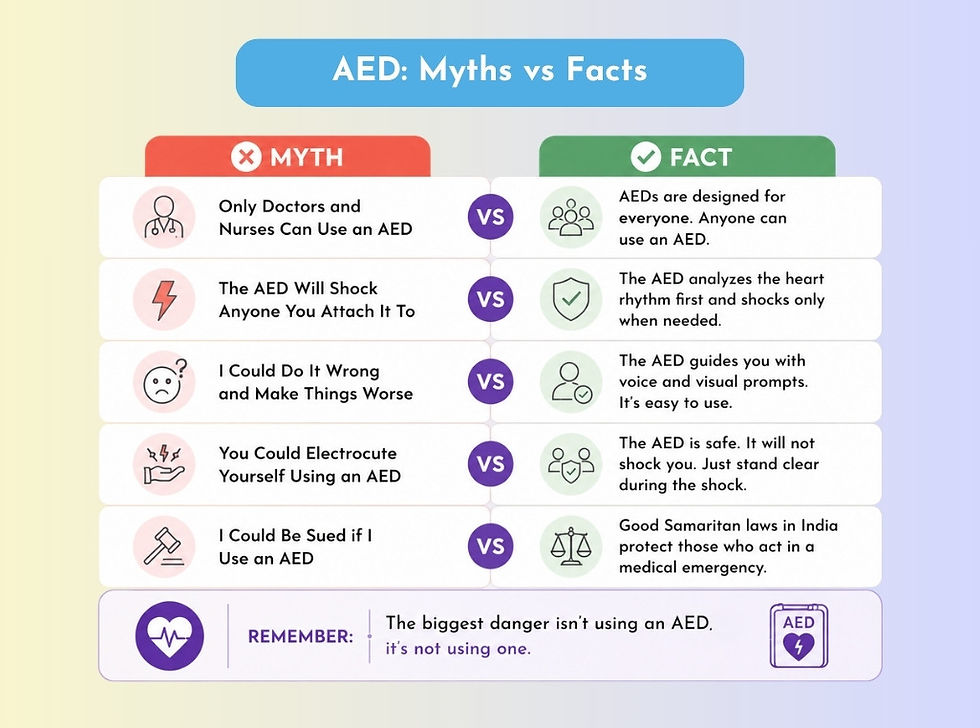
Myth 1: Only Doctors and Nurses Can Use an AED
Fact: AEDs are designed for the average citizen, not just a medical professional.
Each device takes the user through voice and visual cues.
It provides you with information on where to position the pads, when to move clear, and if a shock is needed.
The device makes the clinical judgment. In India, where sudden cardiac arrest occurs in young professionals, athletes, and those who have no cardiac history, the closest person with medical training could be a matter of minutes.
The AED on the wall is intended for use by whoever picks it up.
Myth 2: The AED Will Shock Anyone You Attach It To
Fact: An AED will NOT deliver a shock if there is no shockable heart rhythm.
The device first examines the patient's cardiac rhythm using the electrode pads before taking any action.
It searches for two conditions, ventricular fibrillation and pulseless ventricular tachycardia, where defibrillation is clinically indicated.
In the absence of one or both, the device will not charge or shock, whether the user presses the right button or the wrong one.
This is the most critical safety feature programmed into each public-access AED, and it addresses the biggest concern preventing bystanders from taking action.
Myth 3: I Could Do It Wrong and Make Things Worse
Fact: There is very little a bystander can do wrong with an AED.
A slightly off placement does not mean the device is dangerous. It might not be as effective, but it won't hurt.
The AED remains the facilitator for the entire process. Practicing steps of using a defibrillator on a training device can be much more effective than reading about it and is a better way to overcome hesitation before an emergency.
Think Health India is an Indian health and safety company specializing in emergency preparedness and lifesaving training, including CPR and AED.
They offer training on using an AED using realistic drills using AED trainers, providing training that feels like using the real device without the risk of a shock.
Myth 4: You Could Electrocute Yourself Using an AED
Fact: A rescuer is never recorded as being electrocuted by an AED when it's used properly.
The electric current is delivered via pads on the patient's chest and through the heart itself, not to those standing nearby.
The only precaution needed is that no one touch the patient during the shock.
Instructs all users to stand clear before charging with a voice prompt when using the AED.
After that one instruction, the rest of the process can be absolutely safe for all those in the room.
Myth 5: You Cannot Use an AED on Someone with a Pacemaker
Fact: An AED can be used on someone in cardiac arrest, even if they have a pacemaker or an implanted cardioverter-defibrillator.
Pacemakers are made to withstand an external AED shock. The only practical change is the location of the electrode pads, which should be at least 2.5 centimeters from the raised lump beneath the skin where the pacemaker is placed (usually in the upper chest area).
Do not withhold AED use due to a pacemaker. It's a life-saving measure.
Individuals with existing pacemakers have a prior history of cardiac risk, and are at higher risk (not lower) for a shockable arrhythmia.
Appropriate placement of the defibrillator pads will ensure safe defibrillation without harming the implanted device.
Myth 6: AEDs Are Dangerous Near Water or in Rain
Fact: An AED can be used safely in rain, near a pool, or in humid conditions as long as you take one simple precaution: dry the patient's chest before applying the pads.
When the chest surface is wet, the shock is less effective because the pad does not adhere to the skin, and the current may flow across the skin rather than into the heart.
Drying the chest with a cloth only takes a few seconds. The AED is safe to use on a dry surface when the pads are applied.
The only time moving the patient first is appropriate is if they are in standing water or a puddle (for shock delivery and pad adhesion). Move them away, dry the chest, and continue immediately.
India's coastal regions, hotel pools, outdoor events, and monsoon-season gatherings make this a practically relevant myth to bust.
Wet conditions are not a reason to withhold defibrillation.
Myth 7: You Cannot Use an AED on a Pregnant Woman
Fact: An AED performed on a pregnant woman is safe, and it is the correct thing to do.
The electrical shock goes through the mother's chest and heart. Research confirms it poses no clinically demonstrated risk to the fetus.
More importantly, without defibrillation, the chances of a pregnant woman who collapses in cardiac arrest surviving are very poor, and the chances of her unborn child surviving are directly related to the mother's heart being restored to a normal rhythm.
Both outcomes are worse with each minute of delay. Follow the AED instructions for any patient. Avoid making adjustments or delays due to pregnancy.
Myth 8: You Will Get Sued If Something Goes Wrong
Fact: The Indian laws expressly safeguard the users of an AED during a cardiac emergency, who are acting in good faith.
In 2016, the Government of India issued Good Samaritan Guidelines following a Supreme Court directive, establishing legal protection for bystanders who assist in emergencies with genuine intent to help.
The legal framework around AED use in India is moving toward encouraging emergency intervention, not discouraging it.
Interestingly, the legal liability could be for an organization that had an AED in place but failed to make it accessible and/or maintain it, rather than for the bystander who used it.
The most frequently mentioned reason by Indian bystanders for not intervening is fear of liability. That fear has no factual basis under current law.
Myth 9: An AED Can Restart a Completely Stopped Heart
Fact: AEDs are used to treat an electrical malfunction of the heart, not an electrical failure of the heart.
Sudden cardiac arrest is usually caused by a chaotic electrical system in the heart, characterized by ventricular fibrillation.
The AED's shock breaks that chaos and provides the chance for the heart's natural pacemaker to resume a normal rhythm.
The AED will see a flat line (asystole) when the heart is completely stopped and will advise the user to continue CPR.
CPR is used to maintain blood circulation to the brain until a shockable rhythm occurs or help arrives.
Understanding when to use a defibrillator versus when CPR is the primary intervention is one of the most practically useful things a bystander can know.
Myth 10: AED Maintenance Is Too Complex to Keep Up With
Fact: AED maintenance is straightforward. The challenge is accountability, not complexity.
Most AEDs are designed to self-test daily or weekly automatically and alert the user via a status indicator.
The maintenance includes checking this indicator, replacing the electrode pads when they are due, and replacing the battery when it is due.
The issue faced by most Indian organizations is not that maintenance is difficult.
It is that no one is formally assigned to perform it, and informal reminders break down over time.
The AED management platform, such as AED SmartX, automates the entire process.
It records battery and pad expiration dates on all devices in a program, provides reminders when it's time to replace batteries, and maintains a compliance log for safety audits.
For a company managing AEDs across multiple floors or a hotel group with properties across different places, this kind of centralized oversight is the difference between a device that works in an emergency and one that does not.
The Experience of Using an AED in India
A person falls in your office. A colleague retrieves the AED from its clearly marked AED wall cabinet in the lobby.
The device turns on and guides: Place the pads here and stand back, analyzing now.
The device charges and warns to press the button when a shock is necessary. Otherwise, it instructs CPR until emergency personnel arrive.
There is no clinical decision-making at any point. The user's only task is to follow the instructions.
AED training pads can be used to practice this sequence until it becomes a reflex, which is likely where the difference between a trained and an untrained bystander is felt most during an emergency.
Safety of Using an AED During an Emergency

Is it safe to use an AED? In each of the myths addressed in the blog, the answer is yes.
It is legally protected by Indian law and built to prevent the errors bystanders fear most.
The device analyzes before it acts. It leads you through each step.
It will not shock unless there is a clinical basis for the shock. It's also open for anyone to use, in any space, whenever necessary.
It isn't the AED that poses the real threat to safety in India. The reluctance is what prevents someone from using it.
For workplaces, schools, hotels, gyms, and housing societies ready to close that gap, Buy AED India provides verified AEDs, AED accessories, maintenance infrastructure, and training resources to prepare you for genuine emergency capability.
Frequently Asked Questions Related to the Safety of Using an AED
1) Is using an AED safe for someone with no medical training?
Yes. AEDs are intended for public use by individuals with no medical training. The machine provides instructions for each step and will not shock unless it senses a shockable rhythm.
2) Can an AED accidentally shock a healthy person?
No. The device only charges and delivers a shock when it detects ventricular fibrillation or pulseless ventricular tachycardia.
3) Is it safe to use an AED on a child?
Yes. Most AEDs have a pediatric mode or have child-sized electrode pads for children under 8 years of age or 25kg.
If there is no pediatric pad, the adult pad can be used by placing one on the front of the chest and one on the back, ensuring no overlap.
4) What legal protection exists in India for someone who uses an AED?
The Good Samaritan Guidelines issued by the Supreme Court in India in 2016 safeguard the bystander who helps in an emergency with good faith.
5) Does using an AED hurt the person receiving the shock?
Patients in ventricular fibrillation are unconscious and do not feel pain from the shock. The electrical discharge is brief, controlled, and calibrated to the minimum level needed to interrupt the arrhythmia.
6) Where can I learn more about which AED suits my workplace or public setting?
The range of verified, brand-authorized AEDs available for Indian workplaces, schools, gyms, and residential complexes is available at Buy AED India, with guidance on matching the right model to your specific setting and risk environment.


Comments