

AED Requirements for Hotels and Resorts in India: What Every Hospitality Property Must Know?

Updated: Jul 24
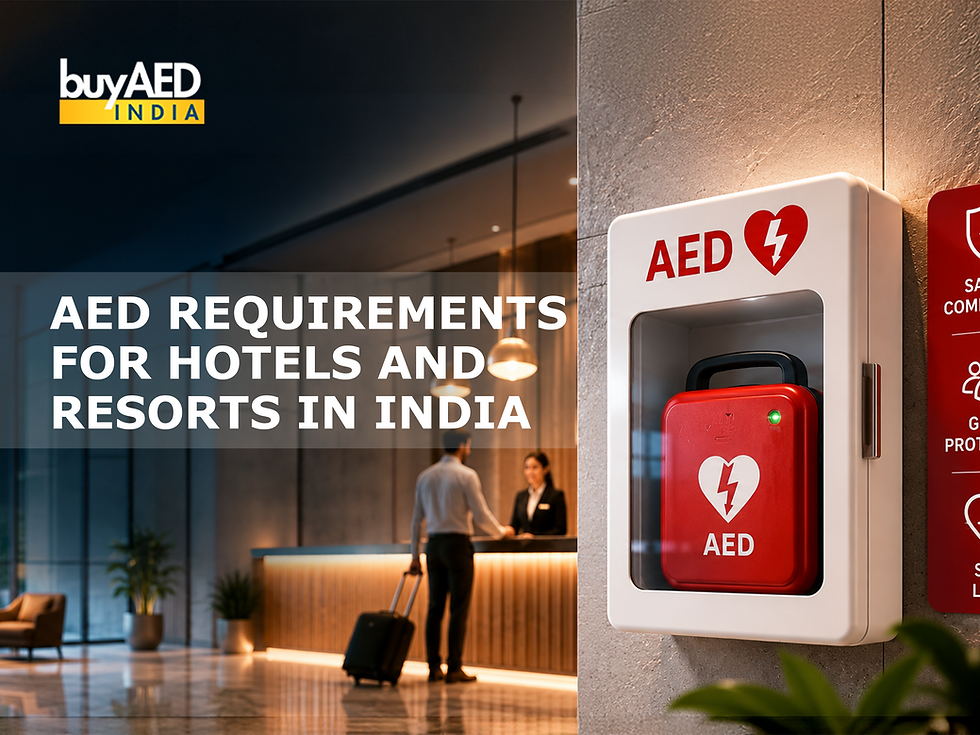
The hospitality industry welcomes millions of visitors to India annually.
Whether they are business travelers, vacationing families, wedding guests, conference participants, or foreign tourists.
With that many people moving through a property every day, a cardiac emergency on the premises is not unlikely. It is inevitable at some point.
More than 7 lakh people die of Sudden Cardiac Arrest in India every year, and almost 80% of the incidents take place outside the hospital.
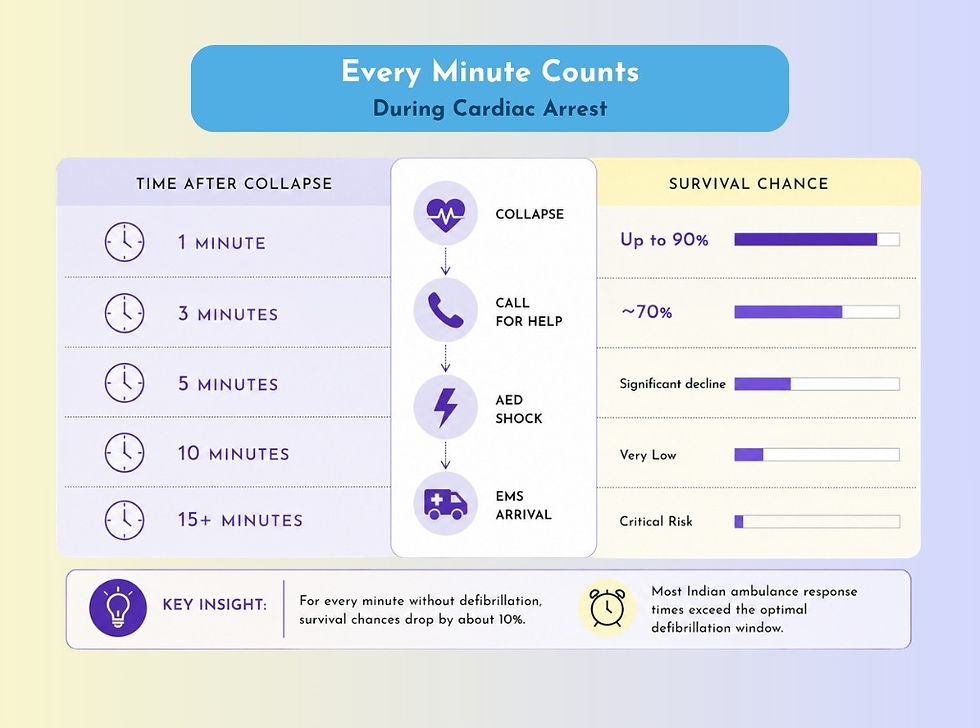
The mean response time in Indian cities is 15-30 minutes, which is far longer than the recommended timeframe for defibrillation to save lives (4-6 minutes).
A response gap that might occur in a hotel room on the fourth floor, on the side of a pool, or at a reception in a banquet hall is no longer a theoretical one in a hotel or resort. It's a true operational risk.
Knowing the AED requirements for hotels and resorts in India is no longer a mere compliance check. For properties that take guest safety seriously, it is a foundational part of emergency preparedness.
What Is the Current Regulatory Position in India?
There is no universally mandated AED law in India that applies specifically to hotels.
However, the regulatory landscape is shifting, and a clear picture is emerging from multiple directions.
In India, hotel star classification is governed by the Hotel and Restaurant Approval and Classification Committee under the Ministry of Tourism.
Cardiac response equipment is increasingly discussed in safety inspections for 4-star and 5-star properties.
At the same time, the broader category of emergency medical preparedness is referenced in the published guidelines as part of the classification criteria, alongside fire safety measures, structural standards, and health facilities.
Additionally, India's Consumer Protection Act, 2019, imposes an active duty of care on premises with guests.
This is a framework that poses real legal risk for a hotel that does not have basic cardiac emergency equipment and loses a member of its staff to a preventable cardiac event.
The absence of an AED is increasingly difficult to justify to insurers, regulatory inspectors, and courts.
Several states in India are also developing their own public safety guidelines that mandate AEDs in high-traffic areas.
Hotels are a high-traffic area by nature. Staying ahead of this regulatory curve is a matter of business continuity.
Why Hotels and Resorts Can Face a Higher Cardiac Risk?
A hotel is more than a building.
It is a compact space where patients and people from various health backgrounds, physical states, and ages get together, maybe under stress, while drinking alcohol, working out at a fitness center, or swimming at the pool.
All of these scenarios contribute to an increased risk of heart disease.
Taken together, this makes the hotel or resort one of the highest-risk areas for SCA outside a hospital environment.
Numerous studies have demonstrated that cardiac events that occur during physical activity are more likely to have shockable rhythms, or rhythms that will respond to defibrillation if a device is readily available.
Survival rates are about 70% if defibrillated within 3 minutes of collapse.
Shock in the first minute brings that number close to 90%. In a large resort where the nearest ambulance can take 20 minutes or more to arrive, an on-site AED is more than supplementary equipment.
Where Should AEDs Be Placed in a Hotel or Resort?
The first mistake hospitality properties make is in placement. One single device in the lobby is not enough to meet security expectations.
That single device will not reach a guest who collapses in a 7th-floor corridor within the timeframe.
The general rule for the placement of an AED in a hotel or resort is that no person on site should be farther from an AED than 3 minutes.
This means that the placement map is practically as follows:
1) Lobby and front desk area
The busiest area in a hotel. A staff member at the front desk is often the first to know of an emergency anywhere on the property, making this a logical point for a device.
2) Fitness center and pool
Two of the highest-risk areas in a hotel are the fitness center and the pool area. Physical exertion at the gym and pool exposure create conditions where cardiac events are more likely.
This is why an AED for gyms & fitness is very important.
3) Banquet halls and conference rooms
A 500-person wedding reception or a 300-person corporate conference is a higher risk event, statistically speaking.
AED placement in or near large event spaces is crucial.
4) Each residential floor or floor cluster
For multi-story hotels, devices installed in a visible spot on every other or third floor or in elevator lobbies can significantly improve emergency response time.
5) Outdoor areas and grounds
For resort properties with large grounds, golf courses, or gardens, a portable AED accessible to security or patrol staff covers the areas that other units cannot reach during an emergency.
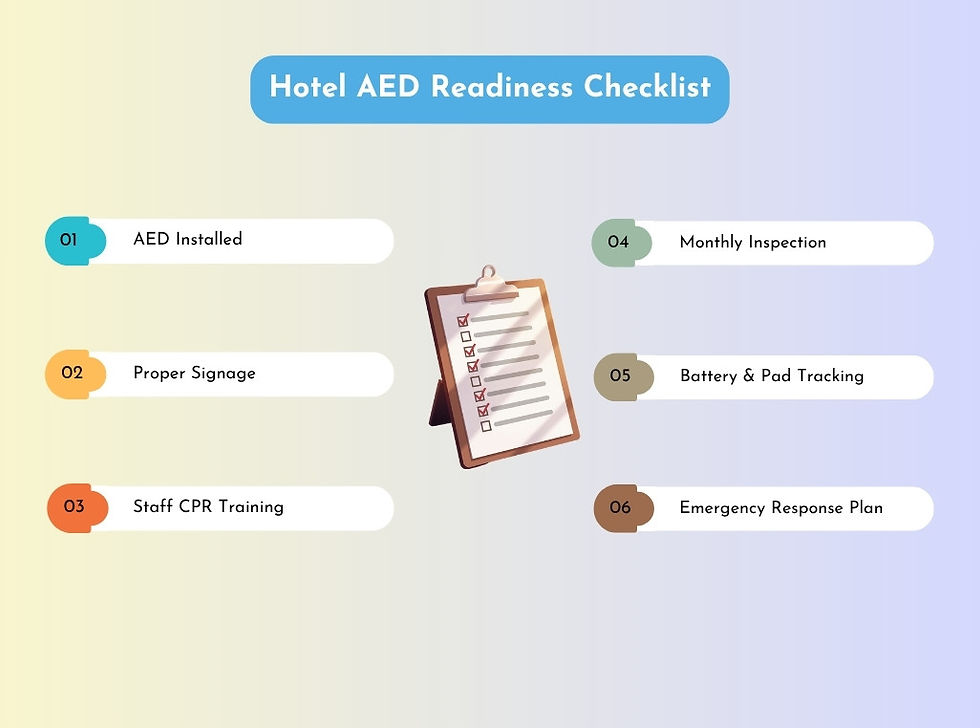
Each device should be mounted in AED wall cabinets with signage and be easily visible. Guests and staff must be able to find it easily.
Universal English and Hindi AED signage eliminates language ambiguity in high-stress situations.
Which Type of AED Is Right for a Hotel Environment?
All AEDs are not created equal. There is a variety of AEDs available in India. Hotels and resorts have specific needs that affect the choice of devices.
1) Voice prompt language
For Indian hospitality properties serving domestic and international guests, an AED with clear English voice prompts is standard.
For some properties that primarily accommodate domestic travelers, it may be useful to prompt in Hindi.
2) IP rating for poolside and outdoor use
IP ratings for devices used near pools and outdoors should be higher to protect them from humidity, water splashes, and temperature fluctuations.
These areas should be protected with an IP54 or higher.
3) Pediatric capability
Hotels for families with young children should have a device capable of delivering a pediatric-adjusted shock.
Pediatric pad capability or a pediatric mode eliminates the need for an additional unit at each location.
4) Self-diagnostic reliability
Hotel employees are not biomedical engineers.
An AED that performs self-checks and alerts to the need for consumable replacement every day is much better suited to a hospitality environment than an AED that must undergo manual testing procedures.
There are a variety of public-access AEDs from brands such as Philips, ZOLL, Cardiac Science, and Defibtech that are appropriate for hotel settings.
They all have unique advantages in the usability, durability, and cycle life of their consumables. It is worthwhile to compare AED models before buying an AED for a multi-location property.
How Many AEDs Does a Hotel Property Need?
It really depends on the size of your property, how many floors you have, and the risks you face. This can be a practical approach:
A 100-room hotel on five levels, with a fitness center, pool, and one banquet hall, requires at least four or five units (lobby, fitness center, pool, banquet hall, and one common-floor unit). Larger properties can scale up accordingly.
A device-per-zone approach is better suited to resort properties with dispersed buildings, heritage wings, or outdoor activity spaces than a device-per-floor approach.
The guiding question is whether a staff member can reach and deploy an AED at any collapse location within 3 minutes.
When buying multiple AEDs for a multi-site deployment, the package may also include improved pricing, matching service cycles, and a single service support team, all of which simplify long-term maintenance for the property.
AED Maintenance: A Responsibility That Does Not End at Purchase
An AED must be attended to at all times to be in a state of rescue readiness. There are expiry dates on electrode pads.
Batteries will drain while idle. There is potential for software to need updates.
A device that has not been inspected in eighteen months may display a ready indicator and still fail to perform correctly during an emergency.
For hotels managing multiple devices across floors and zones, manual tracking is the most common failure point.
This process can be automated through the AED program management platform, AED SmartX.
It monitors device status, sets inspection reminders, notifies management before the pad/battery expires, and maintains a compliance history for all devices on site.
This type of visibility is crucial for a hotel group that owns hotels in multiple cities.
The value of a failure device in an emergency, such as human, legal, and reputational, is not comparable to the cost of replacing a ₹6,000 pad set on schedule.
The Staff Training is the Key to the Success or Failure of the AED
Just having an AED and a trained, confident responder are two different things.
Both are necessary. A device mounted on a wall with no one willing to use it provides only the appearance of preparedness.
The key first responders are the hotel staff, who need to be best equipped to respond effectively.
Security staff should be mobile and radio-linked. Front desk personnel can call for help in mere seconds.
Housekeeping staff rotate on each floor several times a day.
With structured AED and CPR training, each of these groups becomes a layer of real cardiac response capability.
Modern AEDs are voice and visually directed. The purpose of training is not to replace those prompts but to remove any hesitation that can be the greatest time-waster in a cardiac emergency.
A trained staff member can act in seconds. The untrained one could take 30-60 seconds of critical time to read the label on the cabinet.
Think Health, a trusted training partner, offers AED trainer units that simulate the real-life experience of using the AED without delivering a shock.
They make for repeatable, realistic, on-property staff drills, which are ideal.
If your hotel is looking to enhance the capabilities of your internal response team and not just rely on external emergency services, the best investment is to conduct regular drills with trainer units.
For property teams, AED training pads enable them to practice pad placement and follow the entire rescue procedure correctly.
The Reputational and Legal Case for AED Readiness
Not only is it a moral obligation, but there's a business case for AED readiness in Indian hotels and resorts.
International visitors, especially from Europe, North America, and the Gulf, are used to finding AEDs in hotels as part of the standard standard of care.
Medical emergency preparedness is a part of the travel advisory and booking platform's considerations for safety-conscious travelers.
If a cardiac event occurs and leads to legal proceedings, a hotel with a documented AED program (devices, maintenance logs, staff training records) is in a much better position than one without a documented program.
This documentation is not difficult to maintain. It is simply a habit that most properties have not yet established.
In India, the five-star and luxury segments have already begun taking steps towards becoming AED-ready as a brand differentiator.
Guest safety infrastructure is no longer an afterthought for top properties in India that welcome high-net-worth and international guests.
How Buy AED India Supports Hotels and Resorts Across India?
Buy AED India is the platform in India committed to providing verified AEDs from Philips, ZOLL, Cardiac Science, and Defibtech with full brand authorization, regulatory compliance, documentation, and nationwide delivery.
Buy AED India offers expert advice on selecting the right devices, planning their deployment, managing consumables, and training staff for a multi-device environment.
The best AED program begins with equipment that has been verified, placement that is correct, and people who are trained.
Explore all types of certified AEDs & accessories for hotels and resorts, and take a step towards a true standard of emergency preparedness.
AED Requirements for Hotels and Resorts in India
The AED requirements for hotels and resorts in India are a complex mix of regulatory guidance, duty of care, and practical considerations for emergency response in a country where ambulance response times regularly exceed the time.
India's hospitality sector cannot leave this responsibility solely to emergency services.
The real commitment to safety is an AED program. The availability of AEDs in the proper location, in good working order, and accompanied by trained personnel.
If the hotel/resort is ready to build that program, Buy AED India offers the devices, documentation, and support to make it happen.
Frequently Asked Questions
1) Are there regulations in India to make the installation of an AED mandatory in all hotels?
Not yet, but there is a strong compliance rationale given the obligations of consumer protection, HRACC safety standards for star-rated properties, and evolving state-level public safety guidelines.
2) What is the optimal number of AEDs required in a hotel?
One accessible device within three minutes of the collapse points on the property.
3) What is the best AED for a hotel fitness center or pool area?
IP54 or higher-rated devices are suitable for humid conditions such as pools and gyms.
These include Philips HeartStart FRx and ZOLL AED 3.
4) Do hotel staff need certification to use an AED?
Anyone can use an AED in an emergency, with no training needed. But after formal training from certified AED training courses, the confidence, speed, and accuracy of the response can be greatly enhanced.
5) What happens to an AED after it is used in an emergency?
After deployment, the device must be taken out of service for inspection and consumable replacement before being returned to standby.


Comments