

3 Positions for Defibrillation Pads

Updated: Jul 7

Many organizations purchase an AED but think little about one of the most critical components of using it properly: pad placement.
This is important because even the most sophisticated defibrillator can only work when the electrodes are in the correct position.
There is virtually never time to second guess a placement decision in emergency situations.
If trained personnel have a clear understanding of the 3 positions for defibrillation pads, this will help them act fast and confidently.
AED is gradually finding its footing across Indian hospitals, offices, schools, manufacturing plants, airports, and public areas.
But with increasing awareness comes the demand for more than just possession of a device; it's about practical guidance.
Before learning about pad placement, responders also should be familiar with the basics of AED operation by reading a complete how to use an AED guide .
The usage of the device and correct pad placement both play a critical role during a cardiac emergency.
This guide discusses the 3 positions for defibrillation pads, appropriate times for use, frequent pitfalls, and considerations for Indian organizations looking to establish a cardiac emergency response program.
The Significance of AED Pad Placement for Cardiac Arrest Response in India
Defibrillation is the passing of an electrical impulse to the heart designed to reestablish an effective cardiac rhythm in sudden cardiac arrest.
But for this shock to be effective, the electrical pathway must pass through the heart as quickly as possible.
Failure to position it correctly can decrease the effectiveness and cause unnecessary delays in a rescue.
Knowing the 3 positions for the defibrillation pads will give responders a chance to adjust based on the patient's needs and to help remain confident during a stressful event.
Many organizations are thinking more about device selection than training.
Teams can better understand the principles of proper placement by referring to reliable resources, such as this pad placement guide.
Understanding the 3 Positions for Defibrillation Pads Before You Begin
Knowing the 3 positions for defibrillation pads puts responding personnel in the best position to respond promptly when defibrillation scenarios vary from the training setting.
Understanding these locations can help facilitate proper AED utilization and minimize response times in healthcare facilities, workplaces, schools, and public areas throughout India.
The goal is to establish the most effective electrical conduction to the heart using AED guidelines and emergency response protocols.
Position 1: Antero-Lateral Placement
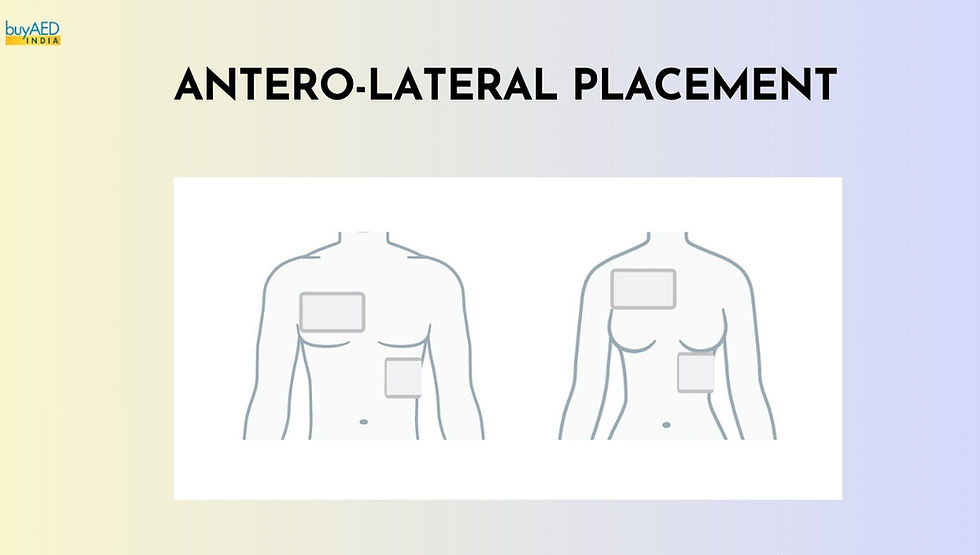
The "antero-lateral" position is considered the standard placement for most cardiac arrest situations in adults.
In this set-up, one pad sits just under the right collar bone and the other pad is placed in the left chest, slightly below the armpit.
This setup provides an efficient, effective electrical conduit through the heart for the AED to be able to push a jolt efficiently if it is needed.
It's also the pattern that's most often shown in AED training programs and emergency response courses since it's easy to learn and implement under pressure.
The antero-lateral position is usually the first position that is taught for workplace, school, hospital or other public access AED programs.
Its simplicity helps lessen hesitation in an emergency and fast action when time is of essence.
It is helpful to know how defibrillator pads work, as this will further emphasize the importance of correct defibrillator pad placement for effective defibrillation.
The antero-lateral arrangement is easy to recognize and is usually the first used by responders during both AED training and practical application by the average person.
It will remain the most used and most recommended pad position of the 3 position options for defibrillating pads.
Position 2: Antero-Posterior Placement

The second of the 3 spots to place defibrillation pads is antero-posterior placement.
In this configuration, one pad is attached to the chest in front and the other pad to the back of the patient.
This configuration offers an electrical circuit for the shock to travel across the front to the back of the heart.
Medical staff can opt for the placement when the standard antero-lateral position is challenging to employ.
This occurs because of such things as dressings, implanted medical devices, space constraints, and body structure.
While not as common as the standard position, it is still another critical placement of the 3 defibrillation pad locations.
Emergency situations can vary significantly from one patient to another.
Knowing how to use it when needed can make them better equipped and more confident in the event of a cardiac emergency.
To learn more about how the AED delivers shocks and how the device works, check out AED mechanics.
Position 3: Postero-Lateral Placement
The third pad site position of the 3 defibrillation pad sites is called postero-lateral placement.
In this setup, the first pad is carried on the front or side of the chest, and the second pad is set towards the back of the torso.
This configuration allows the electrical current to pass through the heart effectively to aid the defibrillation procedure if necessary.
It's not as widely discussed in basic AED training as the regular position but can be a viable alternative when the regular pad site may be difficult to use.
Alternatively, this placement might be necessary based on patient factors like the shape of the body, the presence of other medical implants, and accessibility to the chest area.
It's important for responders to understand the 3 positions for defibrillation pads so that they can adapt to various emergency scenarios with confidence.
How to Choose the Right Defibrillation Pad Placement for AED Use in India?
While it's crucial to know the 3 positions for where to place defibrillation pads, not all of these placements are created equal in terms of its frequency of use.
For most adult cardiac arrest scenarios, the standard antero-lateral placement is the most recommended and simplest application, with the ability to be placed quickly.
Other positions may be used where the normal position is not feasible because of patient anatomy, the presence of medical devices, or other factors.
In any placement, responders should proceed as directed by their local training and AED (Automated External Defibrillator) voice prompts.
Pad compatibility is important to know as well, so that organizations are equipped with the right accessories for their model of AED.
4 Common AED Pad Placement Mistakes

Even trained responders can make simple mistakes when they are under pressure. Common issues include:
1. Placing Pads Too Close Together:
Pads should be placed as stated by the manufacturers. Too close together can impact delivery of shock.
2. Applying Pads Over Clothing:
Pads should be applied to bare skin if possible.
3. Ignoring Device Instructions:
Today's AEDs offer voice and visual prompts to help responders through the steps of the rescue process.
4. Using Expired Pads
Pads have expiration dates and should be inspected regularly. Pad change recommendations should be addressed in routine readiness planning.
However, these practical considerations are just as significant as knowing the 3 positions for defibrillation pads.
The Importance of AED Readiness in India
There has been a progress towards increasing awareness of sudden cardiac arrest preparedness in India, and many organizations have enhanced their emergency response capacities.
AED are now being used in corporate offices, schools, hospitals, shopping centers, hotels, and industrial facilities, as part of the overall safety and health program.
However, readiness goes further than just placing an AED in the building.
Effective staff training, periodic equipment checks, recommended or established replacement cycles, emergency response plans and guidelines, and continuous education regarding proper pad placement should be incorporated into the program.
When an organization looks at its AED maintenance practices, they will often discover that being prepared needs to be an organized and proactive process and not a single investment.
For these reasons, the knowledge of the 3 positions for defibrillation pads should be seen as an integral part of a more extended and effective cardiac emergency response strategy.
AED Components and Defibrillation Pads: What Every Indian AED User Should Know?
The location of the pads is widely known, yet people generally do not have a clear overview of how the overall system works.
Learning about the key components of an AED can help responders understand how the pads, battery, electrodes, and software work together during an emergency.
As teams get more comfortable with their machinery, they are more likely to draw up the confidence to perform when time is critical.
This confidence is especially valuable in the event of a real emergency when the 3 positions for defibrillation pads are utilized.
AED Pad Placement Training in India: How Practice Improves Emergency Response?
There is no substitute for practice.
AED training identifies placements and creates muscle memory for various scenarios.
Training pads enable teams to practice positioning over and over again without wasting rescue gear.
Training also reinforces when and why the 3 positions for defibrillation pads may be used.
Additionally, many organizations are aware of the benefits of their broader health and preparedness efforts for emergencies.
Think Health adds to this discussion by increasing awareness of life-saving response skills and workplace readiness.
Practicing drills helps decrease hesitation and increase response time.
AED Program Readiness in India
Preparation is the foundation for a strong AED program, and it ensures that people are prepared to act efficiently during a cardiac emergency.
This includes positioning AEDs in highly visible areas, providing regular employee training, regular inspections, making sure the accessories are modern, and setting up a clear plan for emergency response.
Most organizations begin by investigating viable AED solutions and then move on to training and maintenance planning.
Buy AED India can be a useful resource for organizations looking to direct AED implementation and preparedness in India.
For facilities that have multiple devices, keeping spare adult AED pads ensures continuous readiness and efficiency in operations.
3 Positions for Defibrillation Pads: Key Takeaways for Indian AED Readiness
Knowing the 3 positions of defibrillation pads is more than just passing a training course.
It's about assuring people that they can react in one of the most vital medical situations they may have to face in life.
The most typical placement is antero-lateral, but knowing other configurations could be helpful for responders when necessary.
AED readiness for Indian organizations should encompass equipment, training, maintenance, and continuous education.
Organizations that have a basic understanding of the devices as well as of the systems surrounding them can benefit from Buy AED India.
It's all about preparedness whether an organization is considering its placement training strategies, reviewing accessories, or evaluating technologies like AED SmartX.
The 3 positions for defibrillation pads are much easier to remember and much more effective when they are called on at the worst time, if training is consistent and placement principles are understood.
Frequently Asked Questions
1. What are the 3 positions for defibrillation pads?
The three placements most often referred to are the anterior lateral, anterior posterior, and posterior lateral placements.
2. Which position is used most often?
Antero-lateral placement is typically thought of as the default placement in most cases of adult cardiac arrest.
3. Why is pad placement important?
Proper positioning assures good transmittal of electrical shock through the heart.
4. Can non-medical staff learn AED pad placement?
Yes. Modern AED training courses are specifically designed for prepared individuals and healthcare professionals.
5. How often should AED pads be checked?
Pads need to be checked on a routine basis and replaced as directed by the manufacturer and as per the expiry date.


Comments