

Defibrillator Modes Explained: How to Choose the Right AED

Updated: 1 day ago
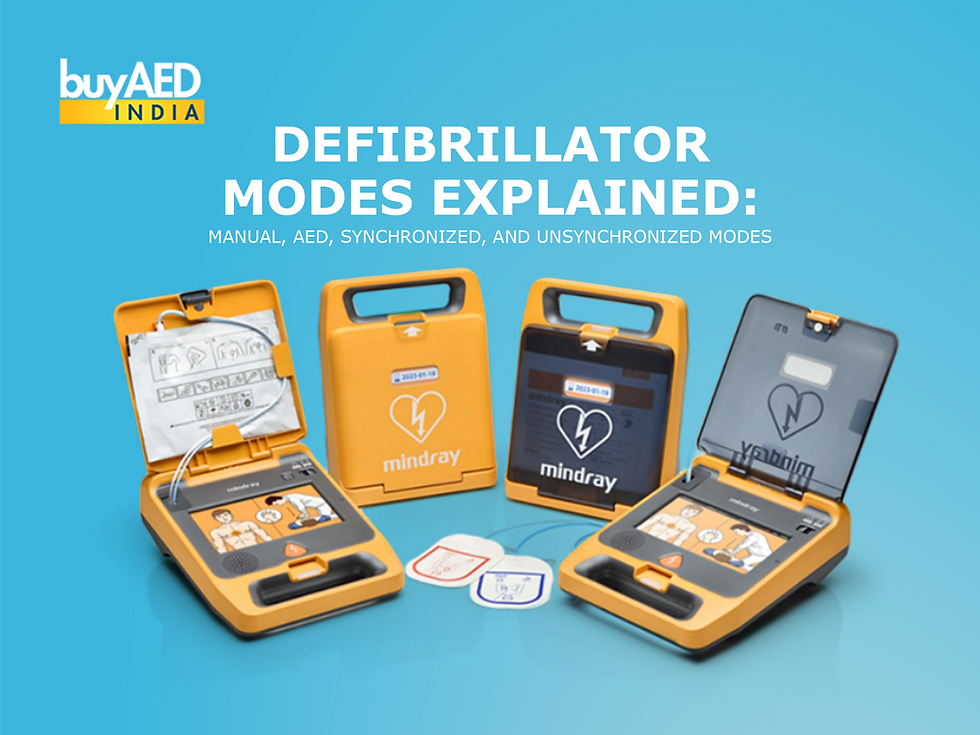
Most conversations around an AED, when applied to a particular organization, are debates about the price, features, or the brand preference for it.
However, one of the most critical aspects is overlooked: defibrillator modes.
A familiarity with defibrillator modes can be the difference between choosing a device that's easy to use in the event of a real emergency and one that will make you think hard when seconds count.
In India, preparedness for emergencies is an increasing priority in public gatherings, schools, offices, factories and residential areas and hospitals.
More institutions are now implementing AED programs and knowing how various devices work is crucial.
Buy AED India is here for this, providing organizations with access to AED devices, accessories, and practical steps for developing effective emergency response systems.
This guide provides an explanation of defibrillator modes in a clear and simple way, enabling decision makers to decide which defibrillator setup is best suited to their circumstances.
What are Defibrillator Modes?
The basic principle of the defibrillator is to assess the heart's rhythm and administer an electric shock if needed to return the heart to a normal beat.
But all devices don't work the same way.
The defibrillator modes to dictate the level of involvement the responder must have while using the defibrillator and how the defibrillator will conduct the rescue.
Some modes are designed specifically for trained medical professionals, while others are intended for ordinary people with little or no medical background.
By understanding these defibrillator modes, organizations can make informed choices regarding which type of equipment best aligns with the training and roles of potential responders.
For buyers considering AED solutions, considering the background and expertise of the organization, revealed by the organization overview, can also deepen the understanding of the AED landscape.
Why Defibrillator Modes Matter in Real Emergencies?
The fact of the ground reality of emergency response in India is that the first responder to help a victim is not usually a cardiologist.
In many cases, it could be a security guard, office administrator, teacher, fitness trainer, factory supervisor, or nurse.
In those few moments, simplicity and confidence are of extreme importance.
Here comes the big role of defibrillator modes.
An instrument suitable for well-trained medical personnel might not be appropriate for a public-access site.
A hospital emergency department, on the other hand, might need something more than just AEDs in the general public.
Selecting the correct defibrillator modes allows responders to respond rapidly without getting confused.
Organizations that are considering full AED solutions can gain an understanding of available options via the AED product collection for various environments.
Different Defibrillator Modes for Indian Hospitals, Offices, and Public Spaces
There are three main modes that are routinely seen with defibrillators.
1. Fully Automatic Mode:

For a fully automatic AED, the machine doesn't require manual intervention and automatically detects the patient's heart rhythm to deliver a shock as needed.
The responder responds to verbal commands, places the pads appropriately, and maintains a distance from the pad when told to do so.
The AED handles the decision-making process.
The following defibrillator modes are especially valuable at sites where responders may lack medical education.
2. Semi-Automatic Mode:

One of the most popular types of AEDs around the world is semi-automatic devices.
The device analyzes the heart rhythm and advises whether a shock is needed. However, the responder must press the shock button to deliver treatment.
These modes of defibrillators are attractive to many organizations. They deliver a degree of automation and control to the responder.
A user-friendly AED is illustrated by the voice-guided AED solution for easy emergency response.
3. Manual Mode:

Manual mode is typically used by healthcare practitioners with training.
In these defibrillator modes, the clinician is responsible for recognizing the rhythm and deciding when and how much energy to apply.
Manual operation is more flexible and requires much more experience.
Usually, automatic or semi-automatic defibrillator modes are more practical for most schools, offices, shopping centers, and residential communities than manual defibrillator modes.
Adult and Pediatric Defibrillator Modes for Indian Schools, Hospitals, and Public Spaces
Not all cardiac emergencies are for adults.
Several contemporary AED models feature special modes, features, or accessories for use on children. These are settings to accommodate younger patients.
Pediatric compatibility should be taken into account when selecting AEDs in schools, education institutions, sports academies, and family-friendly public areas.
This guide to AED readiness in schools are a helpful resource for understanding school preparedness.
Organizations must also make sure proper pads are compatible and compatible with the devices that are chosen.
Knowing what kind of pads your AED uses can help prevent delays in the event of an emergency.
Pediatric support is one of the modes often forgotten when it comes to defibrillators and is very relevant within an education setting.
Training Mode and Voice Guidance in AEDs for Indian Emergency Response
Today, AED technology has come a long way.
Several units now come with training specific defibrillator modes and assistive features to ensure responders complete critical tasks successfully.
Voice prompts give step-by-step instructions, which keep the user calm and focused during the rescue process.
This is particularly helpful in India where emergency response teams may involve non-clinical staff.
Regular training also increases comfort with CPR techniques.
Organizations seeking to enhance preparedness may find it advantageous to consider this CPR guide in conjunction with AED deployment programs.
Community education and awareness initiatives conducted by healthcare organizations like Think Health are valuable for enhancing emergency preparedness.
They also contribute to CPR confidence in various environments.
The most advanced modes of a defibrillator are not necessarily the best to use. These are the ones that people can rely on when an emergency happens.
How Indian Facilities Should Choose Defibrillator Modes?
Choosing the correct defibrillator modes begins with deciding where a defibrillator is to be placed and how it will be utilized.
It is also crucial to think about who will be likely to use the AED in the event of an emergency.
A hospital emergency department requires a different set of requirements than a corporate office, school, factory, and residential community.
Organizations need to consider the level of skills of prospective responders, which may include the number of persons involved on site.
They should also think about the provision of trained medical staff and whether both adult services and children's services might be needed.
Also, try thinking about the frequency of staff training and who will take responsibility for regular maintenance and readiness tests.
Of course, many buyers look primarily at the purchase price, but it is also important to be ready for long-term maintenance.
Comparing this defibrillator price guide alongside usability, training needs, and ongoing maintenance requirements to help ensure the AED remains effective and ready when needed at most.
Maintenance Matters Regardless of Defibrillator Modes
The most sophisticated AED will not provide the benefit if regular maintenance is not performed.
Regardless of the different defibrillator modes that an organization may select, routine inspections are also an important part of maintaining the defibrillator's readiness for emergency use.
AED pads have a set expiration date and must be replaced before they expire; batteries must be replaced regularly to ensure proper performance.
Furthermore, a built-in self-test indicator should be periodically tested to determine if there are any problems that must be resolved.
Knowing the recommended AED maintenance procedures is crucial to ensure equipment remains in working order, regardless of whether it is a standard AED setup or a solution like AED SmartX.
It is also advisable to review guidance provided in an AED maintenance guide, as that can aid in ensuring the device is well maintained and ready to use.
In conclusion, while defibrillator modes are effective, their success relies on regular maintenance and readiness.
5 Common AED Mistakes Organizations Make
Organizations frequently commit unnecessary errors when assessing defibrillator modes that can impact emergency preparedness and emergency response effectiveness.
Assuming all AEDs operate in the same way.
Being exclusively fixated on price and not usability or responder confidence.
Overlooking staff training and routine maintenance requirements.
Being unsure about when an AED should be used during a cardiac emergency.
Selecting a device that does not match the needs of the intended environment.
Knowing these shared challenges and selecting devices based on actual needs can help
guarantee that defibrillator modes enable quicker, safer, and more effective emergency response action.
Where does Buy AED India fit into the Picture?
Choosing the right AED means more than just choosing hardware for organizations to develop their complete emergency response strategy.
It also needs to be compatible with accessories, replacement consumables, training materials, and maintenance.
To simplify this process, Buy AED India has consolidated devices, batteries, cabinets, pads, signage and education resources in one place.
The AED frequently asked question section also provides answers to common operating questions.
Practical guidance is just as valuable as equipment, and as emergency preparedness increases in significance throughout India, access to it has become a critical resource.
Defibrillator Modes in India: Key Takeaways for Hospitals, Schools, and Workplaces
The concept of defibrillator modes is not simply a theoretical matter but a practical approach towards improving preparedness in emergency situations.
These will depend on who its users are, its location, and the urgency with which responders will need to act.
Simplicity and usability are far more important than complexity for most workplaces, schools, residential communities and public facilities in India.
With the expansion of AED use throughout the nation, organizations seek all in one solution for reliability, training support, and long-term readiness.
For more details about the company's mission, expertise, its dedication to enhancing emergency response and more, please visit Buy AED India about Us page.
Platforms like Buy AED India, AED SmartX, and Think Health play a role in fostering a culture of emergency response in this broader journey to preparedness.
They work to develop systems that people can rely upon during critical seconds, for institutions.
Frequently Asked Questions
1. What are the most common modes of a defibrillator?
Common defibrillator modes include fully automatic, semi-automatic, manual, pediatric, and training-oriented configurations.
2. Which defibrillator modes are best for offices?
For the majority of offices, a semi-automatic or automatic defibrillator mode is generally preferred as these are more user friendly for non-medical staff.
3. Do schools need special defibrillator modes?
Devices to consider supporting some pediatric functions, and clear voice guidance should be available in schools.
4. Is the manual mode of defibrillator suitable for public areas?
Manual modes are typically for trained medical practitioners and are not appropriate for public-access environments.
5. Why should organizations choose Buy AED India for AED solutions?
Buy AED India is preferred for AEDs, compatibility with the accessory products, maintenance services, training materials and streamlined emergency readiness in hospitals, schools, workplace and public premises.


Comments